
Let’s be honest: buying hearing aids isn’t like picking up a new phone. You’re looking at an investment anywhere from ₹1,50,000 to ₹4,60,000—and that’s just the financial part. The real stakes? Your ability to join conversations at family dinners, catch what your grandkids are saying, stay engaged at work, and maintain the social connections that keep you mentally healthy.
Both Signia and Unitron sit in similar price ranges (₹42,000–₹2,30,000 per device) and handle everything from mild to profound hearing loss. Both offer rechargeable models with Bluetooth. So why does choosing between them feel so complicated? Because they take fundamentally different approaches to solving the same problem.
Think of it this way:
- Signia is like buying a high-performance sports car—cutting-edge technology, top-tier processing power, designed for people who face challenging listening situations daily
- Unitron is like getting a luxury vehicle with a flexible lease—solid technology from the same parent company as premium brands (Phonak), but with unique “try before you buy” and upgrade options that reduce your risk
What You’ll Learn in This Guide
We’re cutting through the marketing fluff to give you: ✓ Plain-English explanations of how each brand’s technology actually works
✓ Every model’s specs, from tiny invisible devices to powerful behind-the-ear units
✓ Real pricing breakdowns (including those accessory costs nobody mentions upfront)
✓ Honest user feedback—both the raves and the rants
✓ A clear framework to match YOUR specific needs to the right brand
Who Makes Signia?
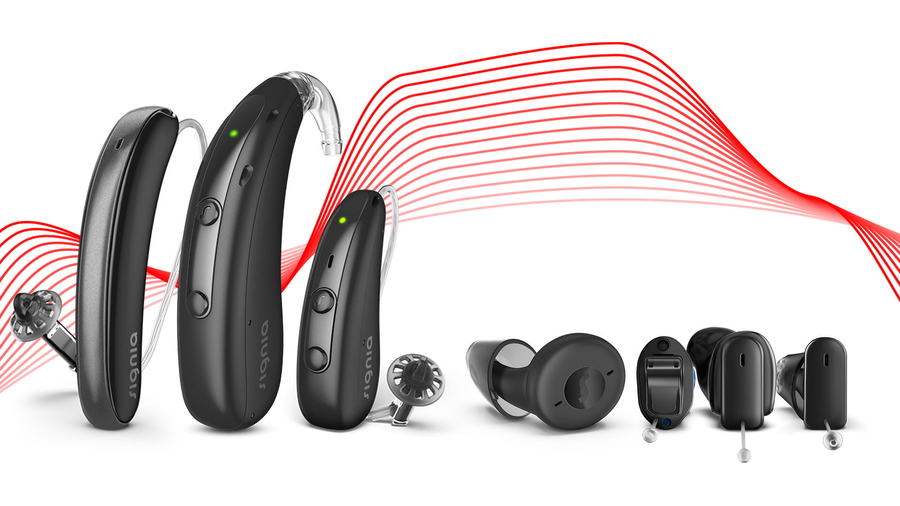
Signia comes from WS Audiology and evolved from Siemens (yes, the same company that makes appliances and industrial equipment). They’ve positioned themselves as the tech innovators of the hearing aid world.
Understanding Signia’s Technology: The Evolution Story
Here’s something most companies won’t tell you: it takes over 5 years to develop a new hearing aid platform. Signia doesn’t just slap new features onto old tech—they rebuild from the ground up. Let’s trace their journey:
The Platform Timeline (What Each Generation Brought You)
2017 – NX Platform: “The Own Voice Revolution”
The breakthrough? Own Voice Processing (OVP™). If you’ve ever worn hearing aids and thought “Do I really sound that weird?” this was the fix. It made your own voice sound natural again—a game-changer that sounds simple but required sophisticated processing.
2019 – X Platform: “Technology That Moves With You”
Added acoustic-motion sensors. Translation: your hearing aids could tell when you were walking, running, or standing still, and adjust sound accordingly. They could also track where sounds were coming from. Think of it as GPS for sound.
2021/2022 – AX Platform: “The Split-Processing Breakthrough”
This is where things got interesting. Signia divided sound into two independent streams:
- Front stream (focus): Speech and sounds you want to hear
- Back stream (surrounding): Background noise
Each stream got processed separately and differently. It’s like having two audio engineers working simultaneously—one enhancing your friend’s voice, another managing the restaurant clatter.
2023 – IX Platform: “Multi-Speaker Tracking” (Their Current Flagship)
Built on AX’s foundation but added something revolutionary: RealTime Conversation Enhancement (RTCE). This is the tech that sets Signia apart right now.
The IX Platform Deep Dive: What Makes It Special
Launched October 2023, the IX platform is Signia’s answer to the biggest complaint hearing aid users have: “I can’t follow conversations when multiple people are talking.”
How RealTime Conversation Enhancement Actually Works
Think of RTCE as a super-smart audio director at a live event, constantly adjusting spotlights on different speakers. Here’s the three-step process:
1. ANALYZE (The Detection Phase)
- Processes 192,000 data points per second (that’s like taking 192,000 snapshots of sound every second)
- Detects who’s speaking, where they are, and how the conversation is laid out
- Tracks movement—if someone walks while talking, the system follows them
2. AUGMENT (The Enhancement Phase)
- Creates multiple independent focus streams—not just one
- This means it can highlight several speakers simultaneously, each against the background noise
- Background noise gets its own separate processing path
3. ADAPT (The Continuous Adjustment Phase)
- Updates the entire sound scene 1,000 times per second
- Constantly adapts as people move, new speakers join, or others leave the conversation
- It’s like having a sound engineer making a thousand micro-adjustments every single second
Does It Actually Work? The Numbers
Signia claims—and internal studies back this up:
- 1.5 dB improvement in speech-in-noise performance vs. leading competitors (that translates to about 24% better speech intelligibility)
- 95% of study participants performed better with RTCE turned on vs. off
What this means for you: In a noisy restaurant with your family, you could potentially understand nearly a quarter more of what’s being said compared to other premium hearing aids.
The AX Platform: Still Relevant?
Introduced September 2022, AX established the split-processing architecture that IX now perfects. If IX isn’t in your budget, AX models still offer:
Core Technology:
- Augmented Focus™: That same front/back sound separation we talked about
- Own Voice Processing 2.0: Your voice sounds natural
- Auto EchoShield: Cuts down on that annoying echo in large rooms
- eWindScreen: Reduces wind noise (great if you walk or bike outdoors)
Practical Benefits:
- Some models offer up to 36 hours of battery life on a single charge (that’s longer than most competitors)
- Direct streaming from both iOS and compatible Android phones
- Still represents excellent technology, just not the absolute cutting edge
Current Signia Models: Your Options Explained
IX Platform Models (Latest, 2023+)
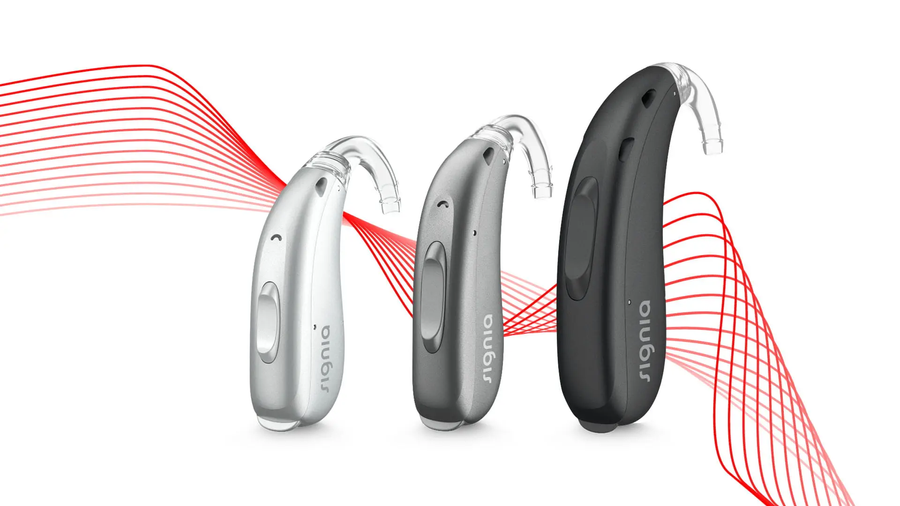
Pure Charge&Go IX Family (The Flagship Line)
- Pure Charge&Go BCT IX: The top-tier model with Bluetooth Classic for universal smartphone connectivity + 36-hour battery life
- Also available in models with Bluetooth LE Audio (newer, more efficient Bluetooth)
- This is the receiver-in-canal (RIC) style—wire goes over your ear, receiver sits in canal
Silk Charge&Go IX (The Invisible Option)
- Completely-in-canal (CIC) style with instant-fit silicone sleeve
- Trade-off: No Bluetooth streaming (too tiny for the antenna)
- Benefit: Nearly invisible, rechargeable (rare for CIC models), has binaural directionality (both ears work together)
- Great if discretion trumps connectivity for you
Active Pro IX (The Earbud Style)
- Looks like premium earbuds, functions as high-end hearing aids
- Scored in the top 5% in lab tests
- Bluetooth streaming included
- Perfect if you want hearing help without the “hearing aid look”
Styletto IX (The Fashion-Forward Choice)
- Slim, stylish RIC design
- Won an Expert Choice Award for performance
- For users who want both cutting-edge tech AND aesthetics
AX Platform Models (Previous Generation, Still Excellent)
- Rechargeable RIC with Augmented Focus and OVP 2.0
- Same form factor as IX models, slightly older processing
Insio Charge&Go AX (Historic First)
- World’s first wireless-charging custom in-the-ear (ITE) hearing aid
- Custom-molded to your ear
- Great for people who prefer ITE style with modern charging convenience
Legacy Models: X and NX Platforms
These older platforms introduced key technologies (Own Voice Processing, motion sensors) and are often available at more affordable price points as legacy products. If budget is tight, don’t dismiss them—they’re still solid technology, just not the newest.
Technology Levels: The Tier System
Like most manufacturers, Signia offers different technology levels (typically Essential, Standard, Advanced, Premium). Higher tiers unlock:
- More sophisticated noise reduction algorithms
- Better directional microphone performance
- More customizable programs
- Advanced features like RTCE
Pricing reality: Expect to pay around ₹3,500 per device (₹7,000 per pair) at premium levels, with lower tiers reducing that cost.
The Real User Experience: What People Actually Say
The Praise:
✓ Exceptional sound clarity, especially in complex listening environments
✓ Sleek, modern designs that don’t scream “hearing aid”
✓ IX platform’s multi-speaker tracking genuinely helps in group settings
✓ Long battery life on rechargeable models
The Problems:
✗ Significant reliability concerns reported by multiple users
✗ Connectivity frustrations—Bluetooth can be finicky
✗ Some users report frequent repairs needed
✗ Customer service experiences vary widely
Bottom line: Signia delivers on technology promises but has quality control challenges that prospective buyers should consider.
Who Makes Unitron?
Unitron has a fascinating backstory. Founded in 1964 in Newfoundland, Canada as Canada’s first-ever hearing aid manufacturer. In 2000, they were acquired by Sonova Group (the Swiss powerhouse that also owns Phonak and Hansaton).
Why this matters: Unitron shares core hardware and research with Phonak—one of the industry’s most respected brands—but positions itself differently in the market. Think of it as getting Lexus engineering at a Toyota price point.
They now operate in over 100 countries with 28 global locations and maintain an in-house development center in Kitchener, Canada, with over 100 experts in audiology, engineering, and software.
Unitron’s Design Philosophy
They’ve won 12+ Red Dot Design Awards and center everything on three pillars:
- “Easy to Hear”: Superior sound performance and connectivity
- “Easy to Wear”: Comfortable, stylish design
- “Easy for You”: Tools that make life simpler for both users and professionals
Understanding Unitron’s Technology Platforms
Unitron releases new platforms roughly every 2 years. Here’s what you need to know about each generation:
Smile Platform (2025) – The Current Flagship
Launched: March 2025 (Moxi S-R), expanded January 2026 (custom Insera models)
Core Technology:
- ERA™ processor: Sonova’s newest chip (same parent company as Phonak)
- AI-trained Integra OS: Uses artificial intelligence to optimize sound
- 8-environment detection: Automatically recognizes whether you’re in a restaurant, car, concert hall, quiet room, etc., and adjusts accordingly
Debut Models:
Moxi S-R: Receiver-in-Canal, rechargeable
Insera S-R: Custom rechargeable ITE (just added January 2026)
Insera S NW O: Discreet non-wireless custom model
Key Features:
- HyperFocus: Enhanced conversation clarity in noise (we’ll explain this more below)
- Speech Enhancement: Reduces the mental effort required to listen
- Dramatically improved Bluetooth: Up to 6x more transmission power than previous models (bigger range, more stable connections)
Vivante Platform (2023) – The Premium Workhorse
What Makes It Special: Built on Sonova’s PRISM™ chipset with Integra OS, designed for advanced sound performance in challenging situations.
Standout Feature – “360 Conversation in Car”: This is genuinely unique. The program boosts speech from any direction inside a vehicle. If you’ve ever struggled to hear your grandkids in the back seat while driving, this is designed exactly for that scenario.
Technology Tiers: Vivante comes in four levels (9, 7, 5, 3):
- Level 9 (Premium): All features unlocked, including automatic HyperFocus engagement
- Level 7 (Advanced): Most features, some automation reduced
- Level 5 (Standard): Core features, less sophisticated processing
- Level 3 (Essential): Basic features for simpler listening needs
Strategic note: Higher tiers give you more automation and sophistication, not necessarily louder volume.
Blu Platform (2021) – The Style Variety Champion
Key Points:
- Same PRISM™ chipset as Vivante (shared core technology)
- Broader range of styles, including custom in-the-ear (ITE) products
- Introduced “Tap Control”: Double-tap your ear to control streaming and calls (like AirPods)
- Offers power aids for severe hearing losses
Who it’s for: People who want similar core tech to Vivante but need specific styles (especially custom ITEs) or power levels.
Discover Next Platform (2020) – The Budget-Friendly Entry
What You Get:
- SoundCore processing
- 7-environment classification (one fewer than newer platforms)
- Basic Bluetooth (limited to 2 paired devices, 1 active connection at a time)
What You Don’t Get:
- AutoFocus360
- Ability to pair with multiple devices simultaneously
- Latest processing enhancements
Who should consider it: Budget-conscious buyers who need basic connectivity and don’t face highly complex listening situations.
The FLEX Programs: Unitron’s Game-Changing Difference
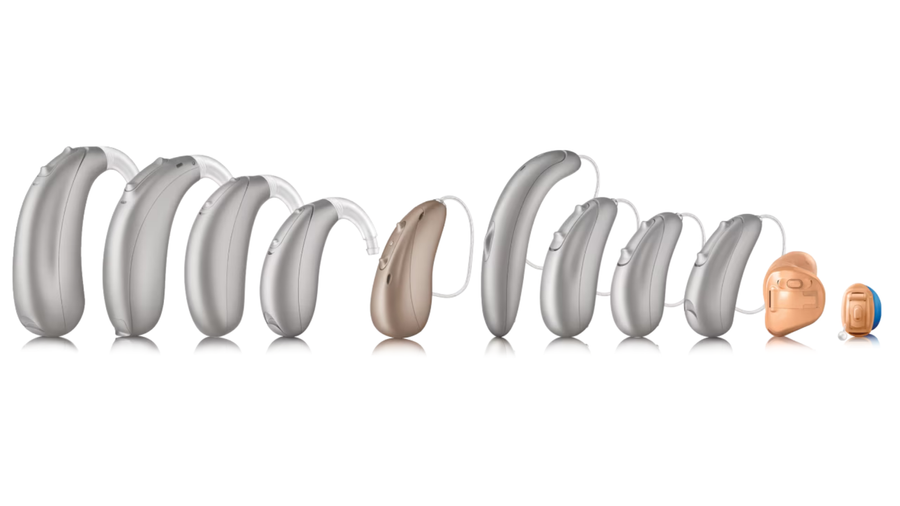
This is where Unitron truly sets itself apart. No other major manufacturer offers anything quite like this:
FLEX:TRIAL – Try Before You Commit
How it works:
- Your hearing care professional programs hearing aids to different technology levels
- You take them home and test them in real-world situations (your favorite restaurant, church, family gatherings)
- Your provider can track your listening ratings through the trial
- You decide which level actually meets your needs based on experience, not showroom demos
The numbers:
- 87% of patients find this trial beneficial
- 99% say it improves their overall experience
Why this matters: Most people buy hearing aids based on a 20-minute fitting appointment in a quiet office. FLEX:TRIAL lets you test in the actual environments where you struggle.
FLEX:UPGRADE – Future-Proof Your Investment
How it works:
- Buy hearing aids at a lower technology level (lower initial cost)
- Within 12-18 months, upgrade to a higher level through software
- Pay only the difference in cost between levels
- Keep your existing physical devices—no new hardware needed
Real-world scenario:
- Start with Level 5 technology at ₹3,00,000
- Realize 6 months later you need better performance in restaurants
- Upgrade to Level 7 for the ₹80,000 difference
- Total spent: ₹3,80,000 vs. buying Level 7 new at ₹4,00,000
Why this matters: Reduces risk if you’re unsure about your needs or budget. Acts as a “safety net” if your hearing or lifestyle changes.
Unitron vs. Phonak: Understanding the Sister Brand Relationship
Since both are owned by Sonova, here’s how they differ:
| Aspect | Unitron | Phonak |
| Pricing | Generally more affordable | Premium positioning |
| Key Advantage | FLEX programs (trial & upgrade flexibility) | Technology leadership, early feature adoption, extensive Roger accessory ecosystem |
| Sound Processing | Emphasizes accurate environment detection and smooth program transitions | Features like Ultra Focus for extreme noise situations |
| Target Customer | Value-conscious buyers wanting flexibility and lower entry cost | Users prioritizing cutting-edge performance, often with more severe hearing loss |
| Hardware | Shared core components from Sonova R&D | Shared core components from Sonova R&D |
The takeaway: You’re getting similar engineering in both brands. Unitron trades Phonak’s premium positioning and exclusive features for better price accessibility and unique flexibility programs.
Unitron Model Families Explained
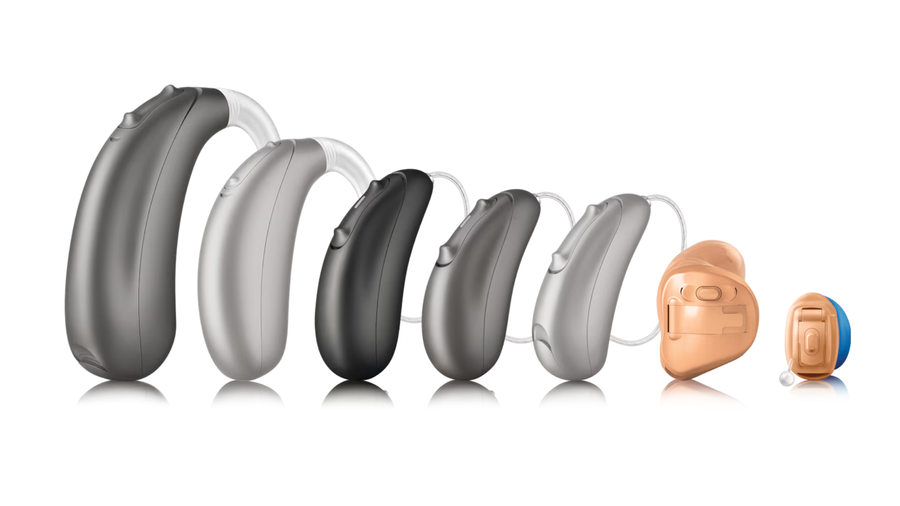
- Moxi (Receiver-in-Canal): The mainstream RIC option, available across all platforms
- Stride (Behind-the-Ear): Traditional BTE style for those who prefer it or need more power
- Max (Power BTE): Specifically for severe to profound hearing loss
- Insera (Custom ITE): Molded to your specific ear shape, multiple styles available
Pricing Reality Check
Expect ₹2,000–₹5,000 per pair depending on model and technology level. This is generally more accessible than comparable Phonak models with similar capabilities.
The Real User Experience: What People Actually Say
The Praise:
✓ Good sound quality, especially at higher tech levels
✓ Long-term durability and reliability
✓ FLEX upgrade path provides real value and peace of mind
✓ Generally positive experiences with the devices themselves
The Problems:
✗ Persistent Bluetooth pairing issues (multiple users report this)
✗ Inconsistent customer service experiences across different providers
✗ Some durability concerns with specific models
✗ Connectivity can be frustrating, especially on older platforms
Bottom line: Unitron offers solid technology at good prices with unique flexibility, but connectivity and service consistency remain pain points.
Key Technologies Explained (Both Brands)
HyperFocus (Unitron): Aggressively focuses on speech directly in front of you while suppressing everything else. Great for one-on-one conversations in noise, but narrows your sound field.
RealTime Conversation Enhancement (Signia IX): Tracks and enhances multiple speakers simultaneously, maintaining awareness of your full sound environment. Better for group conversations.
Bluetooth Classic vs. LE Audio: Classic works with more devices but uses more battery. LE Audio is newer, more efficient, but fewer devices support it yet.
Detailed Model Breakdown: Every Signia and Unitron Hearing Aid Explained
Let me walk you through every model, every feature, and every spec in plain English. This is the comprehensive guide you need when you’re actually ready to choose.
SIGNIA: COMPLETE MODEL GUIDE
Understanding Signia’s Platform Strategy
Before we dive into specific models, here’s what you need to know: Signia doesn’t just make one hearing aid and call it different names. They build entire technology platforms—think of them as operating systems—and then design different physical models that run on those platforms.
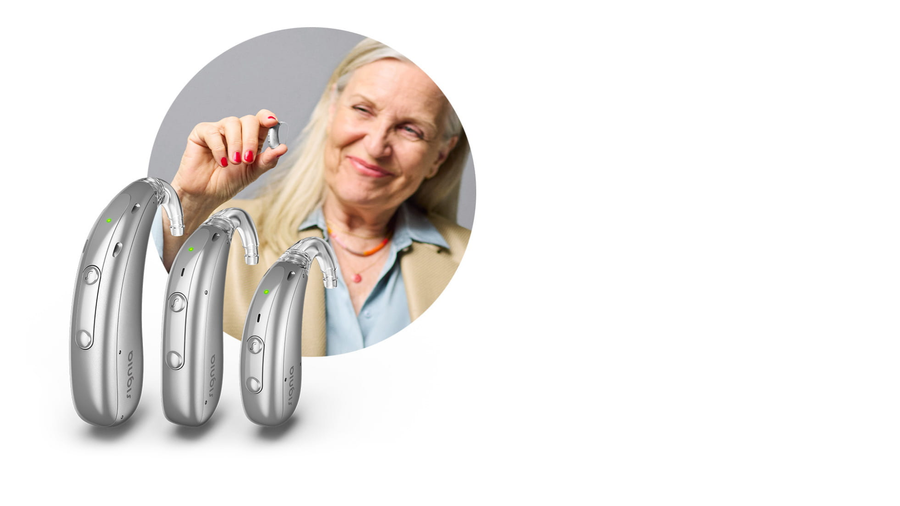
Your hearing aid’s performance depends heavily on which platform powers it. Let’s break down what each one actually does:
The Three Platforms You’ll Encounter
1. Integrated Xperience (IX) Platform – The 2023 Flagship
Released October 2023, this is Signia’s current top-tier technology.
The star feature: RealTime Conversation Enhancement (RTCE)—that multi-stream processing system we discussed earlier that tracks multiple speakers simultaneously.
What you get across all IX models:
- Bluetooth connectivity (either LE Audio or Classic, depending on model)
- Dynamic Soundscape Processing 2.0 (continuously analyzes and adjusts to your environment)
- Own Voice Processing (OVP) 2.0 (makes your own voice sound natural)
- Tinnitus management programs (if you have ringing in your ears)
- Signia mobile app control with AI-driven personalization
Clinical reality: Internal evaluations show “marked improvements” in understanding speech in noisy environments. This is the platform to choose if you regularly struggle in restaurants, meetings, or family gatherings.
2. Augmented Xperience (AX) Platform – The 2022 Generation
Introduced September 2022, this established the dual-stream processing that IX perfected.
How it works: Separates incoming audio into two distinct channels:
- Channel 1: Speech coming from the front (gets enhancement)
- Channel 2: Background sounds (gets suppression)
Think of it like this: Two audio engineers working in parallel—one making voices clearer, one making background noise less distracting.
Who should consider it: If IX is over budget but you still want excellent speech clarity in challenging environments, AX models offer outstanding performance at lower price points.
3. Xperience (X) Platform – The Value Option
Originally launched 2019-2021, this is now Signia’s budget-friendly tier.
What it offers:
- Solid, dependable sound quality
- Motion sensors that automatically adjust sound based on your movement
- Core features without the cutting-edge processing
Who it’s for: Budget-conscious buyers who need reliable amplification but don’t face extremely complex listening situations daily.
Important note: Just because it’s older doesn’t mean it’s bad. Many people are perfectly happy with X platform performance—and it’ll save you considerable money.
SIGNIA MODEL BREAKDOWN: Your Complete Options
Pure Charge&Go IX Series (The Premium RIC Flagship)
Style: Receiver-in-Canal (RIC)—the most popular hearing aid style. A thin wire goes over your ear; the receiver (speaker) sits in your ear canal.
Available Models (Choose Your Connectivity):
Pure Charge&Go IX (Standard)
- Bluetooth LE Audio (newer, more efficient technology)
- Compatible with Auracast (emerging broadcast audio standard—think airport gates, theaters)
Pure Charge&Go T IX (Telecoil Version)
- Everything above PLUS a telecoil for hearing loops in theaters, churches, auditoriums
- Worth the upgrade if you frequent venues with hearing loop systems
Pure Charge&Go BCT IX (The Connectivity Champion)
- Bluetooth Classic instead of LE Audio
- Why this matters: Works with MORE smartphones (broader compatibility)
- Enables hands-free calling for both iOS and Android
- Industry recognition: One of the smallest hearing aids with Bluetooth Classic
Battery Performance (This is Industry-Leading):
BCT IX model specifically:
- Up to 36 hours of use per charge (including 5 hours of streaming)
- Up to 54 hours without streaming
- Translation: Charge every other day instead of daily—huge convenience factor
Charging Options (Your Choice):
- Standard tabletop charger: Basic plug-in charging station
- Portable charging case: Charge on the go, like a phone power bank
- Dry&Clean charger: Charges PLUS uses UV light to sanitize your devices (combats moisture and bacteria)
Real-world benefit: That extra battery life means less anxiety about running out of power mid-day. If you travel, attend long events, or just hate daily charging routines, this is significant.
Styletto IX Series (The Fashion Statement)
The pitch: All the IX platform technology, wrapped in a slim, sleek design that doesn’t look “medical.”
Design Achievement:
- One of the most compact Bluetooth Classic-enabled hearing devices available
- Thin silhouette that many users say looks more like a tech gadget than a hearing aid
Functionality:
- Bluetooth streaming: Yes
- Hands-free calling: Yes (iOS compatible)
- Rechargeable: Yes
Battery Reality Check:
- About 20 hours per charge (less than Pure Charge&Go, trade-off for slimmer design)
- Portable charging case included for extra power cycles on the go
Performance Recognition: Independent testing by HearAdvisor (a respected lab):
- Rated as top-tier performer
- Awarded “Expert Choice Award”
- Specifically praised for superior speech understanding in both quiet AND noisy conditions
Who should choose Styletto:
- Users who prioritize aesthetics alongside performance
- People who don’t need the absolute maximum battery life
- Anyone who wants to make a style statement while addressing hearing loss
Silk Charge&Go IX Series (The Nearly Invisible Option)
Style: Completely-in-Canal (CIC)—sits entirely inside your ear canal
The unique feature: Instant-fit with soft silicone click sleeves
This is rare. Most CIC hearing aids require custom molds made from ear impressions. Silk uses pre-sized silicone sleeves that you can fit immediately—no waiting weeks for custom manufacturing.
Available Sleeve Sizes: Multiple sizes to fit different ear canals (your provider will determine which fits you best)
Key Features:
- Rechargeable (unusual for CIC models—most use tiny disposable batteries)
- Binaural OneMic Directionality: Both ears work together to identify and prioritize speech in conversations
- Nearly invisible when worn
The Trade-Off: No Bluetooth streaming due to compact size (not enough room for the antenna and components)
Battery Life:
- Approximately 20-28 hours per charge
- Comes with portable charging case
Who should choose Silk:
- Discretion is your top priority
- You don’t need/want Bluetooth streaming capabilities
- You want the convenience of rechargeable power
- Your ear canal anatomy accommodates this style (not everyone’s does—provider assessment needed)
Who should NOT choose Silk:
- You need Bluetooth for phone calls, music, or TV streaming
- You have severe hearing loss (these work best for mild to moderate)
- You have dexterity issues (small size can be challenging to handle)
Insio IX Series (The Custom-Molded Options)
The premise: Individually crafted based on impressions of YOUR specific ear canals
Available Styles (From Most to Least Discreet):
1. IIC (Invisible-in-Canal)
- Sits deepest in ear canal
- Truly invisible when worn
- Single microphone (due to size constraints)
- No Bluetooth streaming
- Smallest battery life
2. CIC (Completely-in-Canal)
- Sits in ear canal, barely visible
- Single microphone
- No Bluetooth streaming
- Slightly longer battery life than IIC
3. ITC (In-the-Canal)
- Partially visible in outer ear canal
- Can accommodate dual microphones (better noise management)
- May include Bluetooth on larger ITC models
- Better battery life
4. ITE (In-the-Ear)
- Fills the bowl of your outer ear
- Dual microphones standard (improved directional hearing)
- Bluetooth streaming typically available
- Longest battery life of custom styles
- Easiest to handle (great for dexterity issues)
The Custom Advantage: Perfect fit to your unique ear anatomy means:
- Better comfort for all-day wear
- Reduced feedback (whistling)
- More secure fit (less likely to fall out)
The Custom Disadvantage:
- Requires ear impressions (multiple appointments)
- 2-3 week wait for manufacturing
- Can’t be tried before committing (no returns once custom-made)
- More expensive than instant-fit models
- If your ear shape changes (weight loss/gain, aging), may need remaking
Technology Note: Larger custom styles (ITC, ITE) can include the same IX platform features as RIC models. Smaller styles (IIC, CIC) have feature limitations due to physical size constraints.
Active Pro IX Series (The Earbud Disguise)
The concept: Hearing aid technology in a form factor that looks exactly like premium wireless earbuds
Design:
- Rechargeable
- Instant-fit (no custom molds)
- Shaped like AirPods or similar consumer earbuds
Performance: Built specifically to identify and enhance multiple speakers in complex listening environments (leveraging IX platform’s RTCE)
Lab Testing Results (HearAdvisor): Placed within the top 5% of all tested hearing products
That’s not marketing fluff—this is independent lab performance evaluation.
Connectivity:
- Bluetooth streaming: Yes
- Compatible with: Both Android and iOS devices
- Hands-free calling: Yes
Who should choose Active Pro:
- Younger users who want to avoid “hearing aid stigma”
- Anyone who wants hearing help without the traditional look
- People who already wear earbuds regularly and want that form factor
- Users facing complex multi-speaker environments (meetings, social events)
Consider the trade-offs:
- More visible than in-ear custom styles
- Battery life typically shorter than larger RIC models
- May not provide enough power for severe hearing loss
Motion Series (The High-Power Solutions)
When you need these: Moderate to profound hearing loss—when you need serious amplification power
Style: Behind-the-Ear (BTE)—the full hearing aid sits behind your ear, with a tube connecting to a custom earmold or dome in your ear canal
Why BTE for power: More space = bigger components = more amplification capability + longer battery life
Available Power Levels:
Motion Charge&Go M IX (Moderate to Severe)
- For people who need significant amplification but not maximum power
- Rechargeable lithium-ion battery
Motion Charge&Go P IX (Severe)
- More powerful amplification than M model
- Designed for substantial hearing loss
- Rechargeable
Motion Charge&Go SP IX (Profound)
- Maximum amplification in Signia’s lineup
- For the most severe hearing losses
- Rechargeable
Common Features Across Motion Series:
- All rechargeable (no battery changing)
- Engineered for durability (these are built tough)
- Strong amplification output
- Typically include telecoil for hearing loop compatibility
- Full IX platform features (including RTCE where applicable)
Who needs Motion models:
- Audiogram shows moderate-severe to profound loss
- Other styles don’t provide sufficient amplification
- You need maximum battery life (BTE models typically last longer)
- Durability is a concern (active lifestyle, work environment)
Aesthetic reality: These are the most visible hearing aid style. But if you need the power, visibility is a secondary concern to actually hearing well.
Understanding Signia’s Technology Tiers (The Levels System)
Here’s where pricing gets complicated. Within each model line, Signia offers different technology levels that affect performance and cost.
Think of it like car trim levels: You can buy a Honda Civic LX (basic), EX (mid-tier), or Touring (premium). Same car, different features and performance.
The Three Main Tiers:
Level 7 (Premium) – The Full Experience
- Complete feature set with zero limitations
- RealTime Conversation Enhancement at full capability
- Most sophisticated noise reduction algorithms
- Maximum number of automatic programs
- Best directional microphone performance
- Most customization options for your provider
Expect to pay: Top of the price range
Level 5 (Advanced) – The Sweet Spot for Many
- Strong speech clarity in everyday environments
- Effective background noise control
- Good (not maximum) directional capabilities
- Fewer automatic programs than Level 7
- Some advanced features may operate in simplified mode
Expect to pay: Mid-range pricing
Level 3 (Standard) – Essential Performance
- Fundamental amplification done well
- Basic noise reduction (not advanced algorithms)
- Limited directional microphone sophistication
- Fewer automatic environmental adjustments
- Manual program changes more common
Expect to pay: Entry-level pricing for that model
How to Decide Which Level You Need:
Choose Level 7 if:
- You face complex, demanding listening situations daily (business meetings, large social gatherings, restaurants)
- You want the absolute best performance available
- Budget allows for premium investment
- You need maximum customization capability
Choose Level 5 if:
- You face moderately challenging environments regularly
- You want strong performance but can accept some limitations
- You’re balancing performance needs with budget constraints
- You don’t need every cutting-edge feature
Choose Level 3 if:
- Your listening environments are primarily quiet and simple
- Budget is a significant constraint
- You have mild hearing loss and basic amplification suffices
- You’re willing to manually adjust settings more often
Critical insight: Higher levels don’t necessarily make things LOUDER—they make processing SMARTER. The amplification power is determined by your hearing loss; the technology level determines how intelligently the hearing aid handles complex sound environments.
Signia Pricing Reality
Here’s the frustrating truth: Signia doesn’t publish standardized retail prices.
Why? Because pricing is determined by:
- Your hearing care provider (audiologist, hearing aid dispenser)
- The specific model you choose
- The technology level (3, 5, or 7)
- Included services (follow-up appointments, cleaning, adjustments)
- Warranty and insurance coverage
- Regional market factors
Typical range for a pair: Expect conversations about ₹1,50,000 to ₹4,60,000+ depending on the factors above.
What usually affects pricing most:
- Technology platform (IX > AX > X)
- Technology level (7 > 5 > 3)
- Model complexity (BTE/custom typically cost more than RIC)
- Included service packages
Smart shopping strategy:
- Get quotes from multiple providers for the SAME model and level
- Understand exactly what services are included
- Ask about warranty coverage and what it actually covers
- Clarify the return/exchange policy
- Don’t forget to factor in accessory costs (chargers, cleaning tools, etc.)
UNITRON: COMPLETE MODEL GUIDE
Understanding Unitron’s Product Architecture
Unitron uses a beautifully simple organizing principle: Four product lines, each corresponding to a specific hearing aid style.
Once you know which style suits your needs, you can explore the technology platform and level options within that line. It’s more straightforward than Signia’s approach.
The Four Product Lines Explained:
1. Moxi™ Line = Receiver-in-Canal (RIC)
- Mild to severe hearing loss
- Most popular and technologically advanced Unitron line
- Sleek, discreet designs
- Rechargeable lithium-ion options across multiple platforms
2. Stride™ Line = Behind-the-Ear (BTE)
- Mild to severe hearing loss
- Intuitive controls
- Durable construction
- Both rechargeable AND traditional battery options
- Includes specialized models for more severe losses
3. Max™ Line = Super-Power BTE
- Severe to profound hearing loss
- Maximum amplification power
- Larger disposable batteries (size 13 and 675)
- Focus is power output over discretion
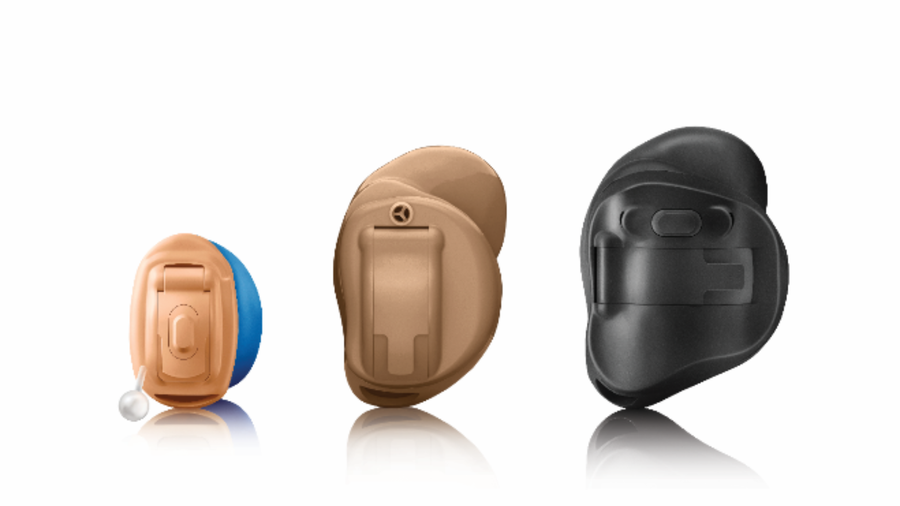
4. Insera™ Line = Custom In-the-Ear (ITE)
- Mild to severe hearing loss
- Custom-molded to your ear
- Multiple styles (IIC, CIC, canal, full-shell)
- Prioritizes discretion and natural sound
- Generally lacks rechargeable options (except newest Smile platform)
- Limited wireless connectivity (except specific models)
The naming makes sense: Once you decide “I want RIC style,” you know you’re looking at the Moxi line. Then you just choose your platform and technology level.
MOXI SERIES (RIC) – THE FLAGSHIP LINE
This is Unitron’s star performer—where they put their newest technology first.
Smile Platform Moxi (2025 – Current Flagship)
Model: Moxi S-R
The “S” means Smile platform; the “R” means Rechargeable
Design:
- Slim, discreet RIC
- Modern aesthetic that doesn’t scream “medical device”
Battery Performance:
- 24 hours of use on a single charge (standard listening)
- 16 hours with 8 hours of streaming (heavy Bluetooth use)
- Full charge: 3 hours
- 80% charge: 1.5 hours (quick top-up option)
Connectivity (This is Where Smile Shines):
- Universal Bluetooth connectivity
- Two active connections simultaneously (phone + tablet, for example)
- Can pair with up to 8 devices total
- Up to 6x more transmission power than previous Unitron platforms
What that 6x transmission power means in practice:
- Greater range (move farther from your phone without dropouts)
- More stable connections (fewer random disconnections)
- Better performance even in wireless environments
Durability:
- IP68 water and dust resistance rating
IP68 explained: Can withstand dust, dirt, and sand + can handle immersion in water up to certain depths. (Don’t go swimming with them, but rain, sweat, and bathroom humidity won’t harm them.)
Technology Features:
- ERA™ processor (Sonova’s newest chip)
- AI-trained Integra OS (sound optimization powered by artificial intelligence)
- 8-environment detection (automatically recognizes: quiet, speech in quiet, speech in noise, noise, music, comfort, car, outdoor)
- HyperFocus (conversation clarity in extreme noise)
- Speech Enhancement (reduces listening effort)
Current availability: Just launched March 2025, so this is the newest Unitron technology you
Vivante Platform Moxi (2023)
Multiple model options here, each with slight variations:
Moxi V-R (The Smallest Rechargeable)
- Smallest rechargeable RIC in Vivante line
- Multi-function button for manual control
- Lithium-ion rechargeable battery
- No telecoil
Moxi V-RT (Rechargeable + Telecoil)
Small rechargeable RIC
- Multi-function button
- Built-in telecoil (for hearing loops in public venues)
- Choose this if you frequent theaters, churches, auditoriums with loop systems
Moxi V-RS (The Stylish Slim Design)
- Unique, stylish slim profile (fashion-forward option)
- Rechargeable
- Multi-function button
- For users who prioritize aesthetics
Moxi V-312 (Battery-Powered Option)
- Identical to Moxi V-R in size and features
- Uses size 312 disposable battery instead of rechargeable
- Choose this if you prefer battery-changing over charging routines
- Good for people who can’t reliably charge daily (travel to remote areas, unreliable electricity)
Platform Features (All Vivante Moxi Models):
- PRISM™ chipset
- Integra OS signal processing
- 360 Conversation in Car program (that unique feature for hearing back-seat passengers)
- 8-environment classification (at Level 9 technology tier)
- HyperFocus capability
- Tap Control available
Blu Platform Moxi (2021)
Older platform, but still excellent technology:
Moxi B-R (Smallest Rechargeable)
- Smallest lithium-ion rechargeable RIC in Blu line
- Introduced Tap Control feature (double-tap your ear to control Bluetooth)
Moxi B-RT (Rechargeable with Telecoil)
- Smallest rechargeable RIC with telecoil
- All B-R features plus hearing loop compatibility
Moxi B-312 (Battery-Powered)
- Smallest RIC using 312 disposable battery
- For users preferring disposable batteries
Platform Differences from Vivante:
- Same PRISM™ chipset as Vivante
- Slightly fewer features (no 8th environment classification)
- Doesn’t include the new magnetic charger design
- Often available at lower prices than Vivante equivalents
STRIDE SERIES (BTE) – POWER AND TRADITIONAL OPTIONS
For users who need/want behind-the-ear style or require more power.
Vivante Platform Stride
Stride V-PR (Small Rechargeable BTE)
- Compact BTE with rechargeable battery
- Good for mild to moderate-severe losses
- Modern rechargeable convenience in BTE form
Stride V-M (Mid-Power with Battery)
- Uses 312 disposable battery
- Pushbutton controls (easy to operate)
- Built-in telecoil
- For moderate to moderately-severe loss
Stride V-SP (Super-Power)
- Size 13 disposable battery (larger than 312, more power)
- Telecoil included
- Pushbutton controls
- For severe hearing loss
Stride V-UP (Ultra-Power)
- Size 675 disposable battery (largest hearing aid battery)
- Maximum amplification in Vivante platform
- Telecoil and pushbutton
- For severe to profound hearing loss
Blu Platform Stride
Stride B-UP (Thinner Power BTE)
- Uses 675 disposable battery
- Thinner design than typical power BTEs (improved aesthetics)
- High amplification output
Stride B-PR (Thinner Power BTE Rechargeable)
- Rechargeable version of power BTE
- Thinner design
- No battery changing
Platform Note: Blu Stride models offer similar power output to Vivante but with the older platform’s processing capabilities.
MAX SERIES (SUPER-POWER BTE) – FOR SEVERE TO PROFOUND LOSS
When you need Max: Your audiogram shows severe to profound hearing loss and standard models don’t provide sufficient amplification.
Battery Types:
- Size 13: For super-power models
- Size 675: For ultra-power models
- All Max models use disposable batteries (no rechargeable options currently)
Why disposable batteries for Max: Power consumption is too high for current rechargeable battery technology to last a full day. Disposable batteries provide the necessary power output.
Focus: Maximum amplification above all else. These are built for functional hearing when you have significant loss, not for discretion or aesthetics.
INSERA SERIES (CUSTOM ITE) – PERSONALIZED FIT OPTIONS
Smile Platform Insera (Launched January 2026 – Brand New!)
This is exciting news: Unitron just expanded Smile to custom models.
Insera S-R (Rechargeable ITE)
Design:
- In-the-Ear model custom-molded to your ear
- Designed to resemble modern earbuds aesthetically
- First rechargeable custom ITE in Unitron’s lineup
Power:
- All-day rechargeable battery
- Effortless drop-in charging (magnetically aligned, just drop it in)
- Automatic on/off functionality (powers on when removed from charger, off when placed back)
Technology:
- Same ERA chip as Moxi S-R (full Smile platform capabilities)
- HyperFocus: Yes
- AutoFocus 360: Yes
- Tap Control: Yes
- All performance levels available
Why this matters: Previously, custom ITEs meant compromising on features and dealing with tiny disposable batteries. Insera S-R gives you custom fit WITH cutting-edge tech and rechargeable power.
Insera S NW O (Discreet Non-Wireless CIC)
The “NW O” means: Non-Wireless, No Optional features (maximally simplified)
Design:
- Completely-in-Canal (CIC)
- Maximum discretion (nearly invisible)
- Custom-molded
Technology:
- Same core ERA chip as S-R
- No connectivity (no Bluetooth, no wireless features)
- No rechargeability (tiny disposable battery)
Who chooses this:
- Discretion is absolute top priority
- Don’t want/need Bluetooth connectivity
- Willing to change tiny batteries regularly
- Want Smile platform sound processing in invisible package
Blu Platform Insera
Insera B-312 (Connected ITE)
- Custom In-the-Ear
- 312 battery (disposable)
- Pushbutton controls (physical button for adjustments)
- Bluetooth included (streaming, calls)
- Good balance of size, features, connectivity
Insera B-312 NW O (ITE with Telecoil, No Bluetooth)
- Custom In-the-Ear
- 312 battery
- Pushbutton controls
- Telecoil for hearing loops
- No Bluetooth (for users who prefer telecoil over wireless streaming)
Insera B-10 NW O (Tiny CIC)
- Completely-in-Canal
- Size 10 battery (very small disposable battery)
- Pushbutton control
- Telecoil included
- No Bluetooth (too small for wireless components)
- Maximum discretion in Blu platform
UNITRON TECHNOLOGY LEVELS: THE 4-TIER SYSTEM
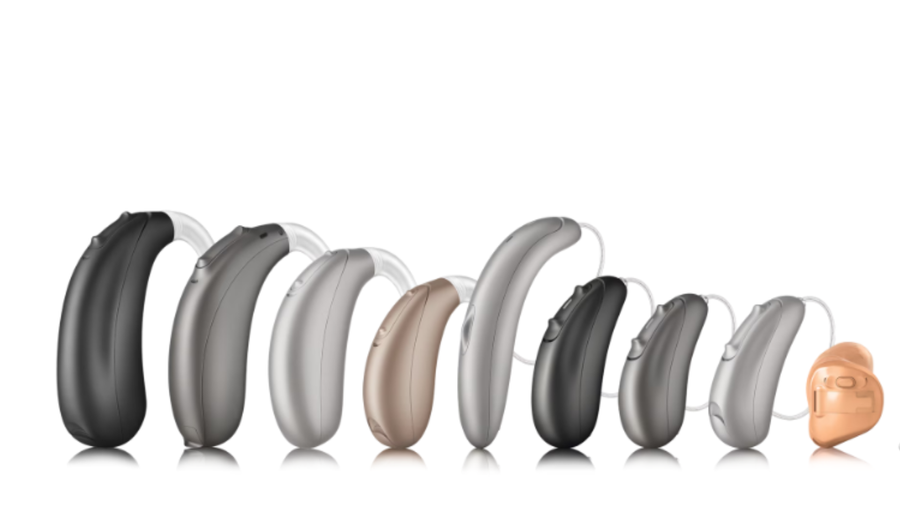
Unitron uses a numbered system: 3, 5, 7, 9 (higher number = more sophisticated)
This is clearer than some manufacturers who use names like “Plus” or “Pro” that don’t indicate hierarchy.
Feature Progression by Level:
| Feature | Level 3 (Essential) | Level 5 (Standard) | Level 7 (Advanced) | Level 9 (Premium) |
| Environmental Categories | 4 distinct environments | 6 environments | 7 environments | 8 environments |
| HyperFocus | No | No | Yes | Yes |
| AutoFocus 360 | No | No | No | Yes (Level 9 exclusive) |
| AutoFocus | No | No | Yes | Advanced version |
| Soft Speech Lift | No | Yes | Yes | Yes |
| Pinna Effect | Basic | 2.0 | 2.0 | 2.0 |
| Speech Enhancement | Yes | Yes | Yes | Yes |
| Dynamic Noise Reduction | Basic | Standard | Enhanced | Maximum |
| Tap Control | Yes (hardware) | Yes | Yes | Yes |
Understanding the Key Features:
Environmental Classification: The hearing aid automatically detects what environment you’re in and adjusts processing accordingly.
- 4 environments (Level 3): Quiet, noise, speech, music (basic)
- 6 environments (Level 5): Adds outdoor, comfort (better adaptation)
- 7 environments (Level 7): Adds car (specific vehicle optimization)
- 8 environments (Level 9): Most sophisticated detection (includes all nuanced situations)
More environments = more precise automatic adjustments = less manual fiddling
HyperFocus (Levels 7 & 9): When sound levels become extremely high, HyperFocus automatically activates in the “conversation in loud noise” setting to dramatically improve speech clarity.
Real-world example: You’re in a very loud restaurant. HyperFocus kicks in automatically, creating a narrow beam focus on the person in front of you while heavily suppressing everything else.
Trade-off: You lose peripheral awareness (can’t hear servers approaching from side), but you CAN hear your dinner companion.
AutoFocus 360 (Level 9 ONLY): Uses a binaural network of four microphones (both hearing aids working together) to determine exactly where speech is coming from.
When speech is from the front: Automatically steers the beamformer (directional focus) + applies dynamic noise reduction
AutoFocus (Level 7): Also uses four-microphone binaural network to detect speech direction.
Difference from 360: If speech comes from a non-front direction, it activates a fixed-wide directional pattern instead of steering the beam. Less sophisticated than Level 9’s steering capability.
Soft Speech Lift (Levels 5, 7, 9): Enhances the subtle nuances of soft speech WITHOUT amplifying low-level environmental noise.
The challenge it solves: When someone whispers or speaks softly, you want to hear them clearly. But you DON’T want to amplify every tiny background sound (rustling paper, distant traffic). Soft Speech Lift selectively boosts only speech characteristics.
Tap Control (ALL Levels): Accelerometer-based hardware feature—it’s built into the physical device, so even Level 3 gets it.
Double-tap your ear (literally tap the hearing aid while wearing it) to:
- Answer/end phone calls
- Play/pause streaming audio
- Activate voice assistants
Why this is great: No fumbling with your phone or tiny hearing aid buttons. Just tap.
Pinna Effect: Mimics the natural sound filtering your outer ear (pinna) provides. Makes sound more natural and helps with sound localization (knowing where sounds come from).
- Basic Pinna Effect (Level 3): Fundamental implementation
- Pinna Effect 2.0 (Levels 5, 7, 9): Enhanced version for more natural sound
PERFORMANCE SPECS: THE NUMBERS THAT MATTER
Battery and Power Management (Rechargeable Models)
Standard Operating Time:
- 24 hours of use on a single charge (typical listening conditions)
With Streaming:
- 8 hours of audio streaming reduces total battery life to 16 hours
Translation: If you stream music or podcasts all day, you’ll need to charge nightly. If you primarily just amplify environmental sound, you could skip a night.
Charging Times:
- Full charge (100%): 3 hours
- Quick charge (80%): 1.5 hours
Practical tip: The 80% quick charge is clutch if you forget to charge overnight. Pop them in the charger while you shower and breakfast—you’ll have most of a day’s power.
Charging Systems (Vary by Platform and Style):
- Smile platform: Redesigned portable chargers (modern, compact)
- Vivante Moxi V-R and V-RT: Magnetic charging cases (magnets align devices properly, easier to use)
- Other models: Standard chargers (effective, less fancy)
Connectivity Specifications (The Bluetooth Details)
Smile & Vivante/Blu Platforms:
- Two devices connected simultaneously (phone + laptop, phone + tablet, etc.)
- Can be paired with up to 8 devices total (though only 2 active at once)
- Switch between devices without re-pairing
Real-world benefit: Pair with your phone, your spouse’s phone, your tablet, your laptop, your TV streamer, etc. Then switch between them as needed without constantly re-pairing.
Discover Next Platform (Older):
- Limited to pairing only 2 devices total
- Only 1 active connection at a time
- Must un-pair to add new devices (frustrating)
Hands-Free Calling: Available on compatible models—your hearing aids function as wireless headsets for phone calls.
What this means: When your phone rings, double-tap your ear to answer. Speak normally; microphones in the hearing aids pick up your voice. Caller’s voice streams directly to your ears. Double-tap to hang up.
Game-changer for: Anyone who struggles to hear phone conversations, especially in noisy environments.
Platform Evolution Comparison
Processor Technology:
- Smile: ERA™ processor with AI-trained Integra OS (newest, smartest)
- Vivante & Blu: PRISM™ chipset (proven, reliable, slightly older)
- Discover Next: SoundCore processing (entry-level)
Environmental Classification Maximum:
- Smile/Vivante Level 9: 8 distinct environments
- Blu Level 7: 7 environments
- Discover Next Level 7: 7 environments
- Level 3 (any platform): 4 environments
Bluetooth Enhancement:
- Smile: Up to 6x more transmission power (massive improvement in range and stability)
- Previous platforms: Standard Bluetooth power
Durability Rating:
- Smile: IP68 water and dust resistance (highest protection level in Unitron lineup)
- Other platforms: Vary by model (generally IP67 or IP68 on newer models)
The evolution pattern: Each new platform brings meaningful improvements in processing power, environmental detection, connectivity, and durability. But older platforms still deliver excellent performance at lower price points.
CHOOSING YOUR UNITRON: DECISION FRAMEWORK
Step 1: Choose Your Style
- Want discretion? → Insera (custom ITE)
- Want convenience/rechargeability? → Moxi (RIC)
- Need maximum power? → Max (super-power BTE)
- Want traditional feel or more power? → Stride (BTE)
Step 2: Choose Your Platform
- Want cutting edge + best connectivity? → Smile
- Want premium features at mid-price? → Vivante
- Want variety of styles + solid features? → Blu
- On tight budget? → Discover Next
Step 3: Choose Your Technology Level
- Complex daily listening environments? → Level 9
- Moderately challenging situations? → Level 7
- Mostly quiet environments? → Level 5
- Budget-focused, simple needs? → Level 3
Step 4: Leverage FLEX
- Unsure which level you need? → FLEX:TRIAL (test different levels at home)
- Budget-conscious now but might need more later? → FLEX:UPGRADE (start lower, upgrade if needed)
PRICING EXPECTATIONS FOR UNITRON
Typical range: ₹2,000–₹5,000 per pair (depending on model, platform, technology level)
General positioning: More affordable than comparable Phonak models with similar core technology
Price drivers:
- Platform (Smile > Vivante > Blu > Discover Next)
- Technology level (9 > 7 > 5 > 3)
- Style (Custom molded > RIC > standard BTE)
- Included services and warranty
FLEX program costs:
- FLEX:TRIAL: Typically no extra cost (included by provider)
- FLEX:UPGRADE: Pay the difference between technology levels (e.g., upgrade from 5 to 7, pay 7-minus-5 cost)
Bottom line on both brands:
Signia gives you cutting-edge sound processing (especially that multi-speaker tracking) in sleek packages, but with reported reliability concerns and premium pricing.
Unitron gives you solid Sonova-engineered technology with unique flexibility programs at more accessible prices, but with some connectivity frustrations and inconsistent service experiences.
Your choice ultimately depends on: your specific hearing loss profile, your daily listening challenges, your budget, and whether you value bleeding-edge tech (Signia) or flexibility and value (Unitron).
Both can serve you well—the key is matching the right brand, model, platform, and technology level to YOUR specific needs and circumstances.
The Money Talk: Complete Pricing Breakdown for Signia and Unitron
Let’s be completely transparent about costs. Hearing aids are expensive, and nobody likes financial surprises. Here’s everything you need to know about what you’ll actually pay.
SIGNIA PRICING: WHAT YOU’LL REALLY SPEND
The Frustrating Reality of Hearing Aid Pricing
Here’s something that drives consumers crazy: Signia doesn’t publish official prices on their website.
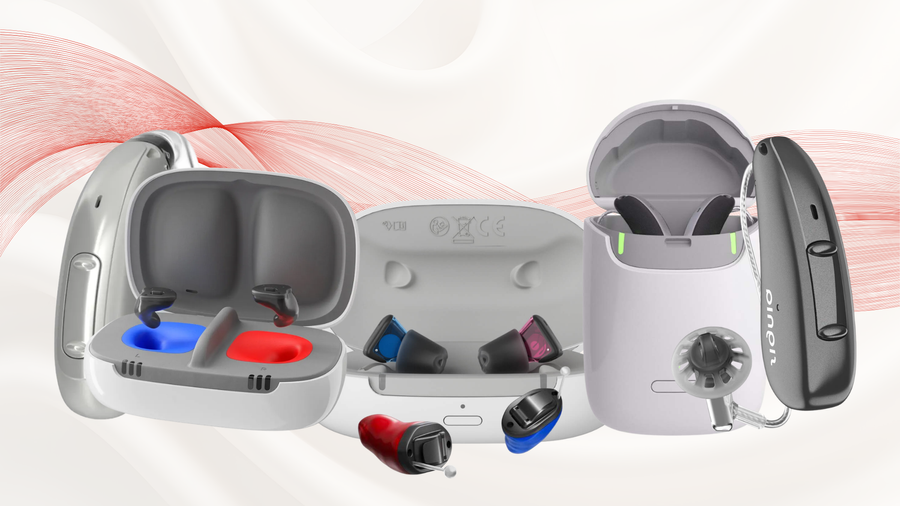
Why? Because the hearing aid industry operates differently than most consumer electronics. Your final price is determined by:
- Your local hearing care professional (audiologist or hearing aid dispenser)
- Geographic location (prices vary by region and country)
- The provider’s service package (some bundle extensive follow-ups, others charge separately)
- Your specific configuration (model, platform, technology level)
- Negotiation (yes, there’s often room to negotiate)
Translation: Two people buying the exact same Signia model in the same city might pay different prices depending on which provider they choose and what services are included.
The Overall Price Range: What to Expect
Based on retailer data, reviews, and market analysis:
Per single hearing aid: ₹21,000 to ₹2,30,000+
Per pair (what most people need): ₹42,000 to ₹4,60,000+
Market positioning: Upper-middle to premium segment—comparable to Phonak, Oticon, and other leading prescription brands.
Reality check: If someone quotes you ₹50,000 for a pair of premium Signia IX hearing aids, they’re either selling you entry-level technology or something’s wrong. Premium IX models typically start around ₹1,50,000+ per pair.
The 6 Factors That Determine Your Final Price
1. Technology Platform (Which Generation You Choose)
Signia releases new platforms every few years, and newer = more expensive.
Current Platform Pricing Hierarchy:
Integrated Xperience (IX) Platform (2023)
- The premium tier
- Features RealTime Conversation Enhancement
- Launched late 2023, so commands top dollar
- Example: Pure Charge&Go IX at premium level can cost ₹90,000+ per device
Augmented Xperience (AX) Platform (2022)
- Mid-premium tier
- Established dual-stream processing
- Often available at reduced prices now that IX is out
- Excellent performance at better value than IX
Xperience (X) Platform (2019-2021)
- Value tier
- Older but still solid technology
- Significantly lower prices as newer models have replaced it
- Great option if budget is a primary concern
Smart shopping tip: If your provider has old stock of AX models and IX just launched, you might negotiate a great deal on excellent technology that’s “last year’s model.”
2. Technology Level (The Performance Tier Within Each Model)
This is where pricing gets really complex. Within each model family, Signia offers different technology levels.
The Level System (1 to 7):
Level 7 (Premium)
- Complete feature set, zero compromises
- All advanced processing algorithms active
- Maximum customization for your audiologist
- Enhanced speech-in-noise performance
- Most automatic programs
- Price impact: Highest cost in that model line
Level 5 (Advanced)
- Strong performance for everyday situations
- Good speech clarity and noise control
- Some features operate in simplified mode
- Fewer automatic programs than Level 7
- Price impact: Mid-range cost
Level 3 (Standard/Essential)
- Fundamental amplification done competently
- Basic noise reduction (not advanced algorithms)
- Limited automatic adjustments
- More manual program changes needed
- Price impact: Entry-level cost in that model line
Real-world price example:
- Pure Charge&Go IX Level 7: ~₹90,000+ per device
- Pure Charge&Go IX Level 5: ~₹60,000-70,000 per device
- Pure Charge&Go IX Level 3: ~₹40,000-50,000 per device
The same physical hearing aid can vary by ₹50,000+ per device just based on which software level is unlocked.
3. Style and Design (Physical Form Factor)
Some styles cost more due to manufacturing complexity or premium positioning.
Price Hierarchy by Style:
Most Expensive:
- Custom-made Insio IX (IIC/CIC): Individual ear molds, precision manufacturing, small size premium
- Active Pro IX: Earbud design, unique form factor, premium positioning
- Styletto IX: Fashion-forward design, slim aesthetics, style premium
Mid-Range:
- Pure Charge&Go IX (RIC): Most popular style, economies of scale keep prices moderate
- Silk Charge&Go IX (CIC): Instant-fit CIC, unique instant-fit advantage adds cost
More Affordable:
- Motion Series (BTE): Larger, more traditional style, often costs less despite power output
- Older platform RIC models: Previous generation Pure or Styletto models
Why custom costs more: Each device requires individual ear impressions, custom manufacturing, cannot be returned/resold, and takes 2-3 weeks to produce. That customization adds ₹10,000-30,000+ to the price.
4. Battery Type (Rechargeable vs. Disposable)
Rechargeable models (lithium-ion) cost more upfront but save money long-term.
Price premium for rechargeable: +₹15,000 to ₹30,000 per device over disposable battery equivalents
Why the premium?
- Lithium-ion battery technology
- Charging circuitry and case included
- Portable charging cases (for many models)
- Advanced charging features (Dry&Clean chargers with UV sanitization)
Long-term savings calculation:
Disposable batteries:
- Size 312 batteries: ~₹178-306 per pack
- Need replacement every 3-7 days
- Annual cost: ~₹8,000-15,000 for both hearing aids
Rechargeable:
- Zero battery replacement costs
- Electricity cost negligible (~₹100-200/year)
- Payback period: Typically 2-3 years
Bottom line: If you plan to use hearing aids for 5+ years, rechargeable pays for itself despite higher upfront cost.
5. Where You Buy (Provider Type and Service Package)
This is HUGE and often overlooked.
Authorized Hearing Care Professional (Audiologist/Dispenser):
Typical package includes:
- Professional hearing evaluation
- Comprehensive fitting (1-2 hours)
- Real ear measurement verification
- Follow-up adjustments (usually 3-6 included visits)
- 3-year manufacturer warranty
- Professional cleaning and maintenance
- Often some accessories (basic charger, domes, wax guards)
Price: Higher upfront, but comprehensive service
Discount Networks or Online Sellers:
Typical package includes:
- Hearing aids shipped directly
- Remote programming (via app/video)
- Limited or no in-person service
- Basic warranty (may be manufacturer only)
- Accessories sold separately
Price: Lower upfront (can save ₹30,000-80,000), but limited support
The trade-off: Are you comfortable with less hands-on professional support to save money? Or do you value the relationship with a local provider who knows your hearing needs?
Critical consideration: If something goes wrong (feedback issues, programming problems, fit concerns), having a local professional is invaluable. Cheap can become expensive if you need help.
6. Geographic Location
Prices vary significantly by region:
Metropolitan areas (Mumbai, Delhi, Bangalore):
- Higher overhead for providers
- More competition (can sometimes drive prices down)
- Access to latest models first
- Typical premium: +10-20% over smaller cities
Tier 2/3 cities:
- Lower overhead
- Fewer providers (less competition)
- May have older stock
- Generally more affordable
Rural areas:
- Fewest options
- May require travel to larger cities
- Limited service providers
- Prices vary wildly
Signia Market Comparison: How They Stack Up
Here’s how Signia pricing compares to major competitors (all prices per pair):
| Brand | Price Range (per pair) | Key Technological Focus |
| Signia | ₹90,000 – ₹4,60,000 | Speech understanding in noise (IX/AX platforms), Own Voice Processing |
| Phonak | ₹1,32,000 – ₹5,00,000 | Universal connectivity, Roger microphone system |
| Oticon | ₹1,50,000 – ₹5,50,000 | BrainHearing, more natural sound processing |
| Resound | ₹54,000 – ₹3,00,000 | Reliable, essential, high-quality hearing solutions |
| Widex | ₹1,50,000 – ₹5,00,000 | PureSound technology, SoundSense Learn |
| Unitron | ₹1,50,000 – ₹4,60,000 | User-centric hearing solutions with natural sound quality |
Key insights:
- Signia’s entry price (₹90,000) is mid-range among premium brands
- Their premium models compete directly with Phonak, Oticon, and Widex at the high end
- Resound offers lower entry pricing but similar top-end costs
- Unitron matches Signia’s range but often delivers more value at comparable tech levels
Signia’s Value Proposition: What You’re Paying For
When you choose Signia at premium prices, here’s what justifies the cost:
Advanced Speech-in-Noise Technology:
- RealTime Conversation Enhancement (IX platform) tracks multiple moving speakers
- Clinical studies show 24% intelligibility improvement over competitors
- 95% of users report better performance in group conversations
Long Battery Life:
- Up to 36 hours on Pure Charge&Go BCT IX (including 5 hours streaming)
- Up to 54 hours without streaming
- Industry-leading runtime reduces charging anxiety
Comprehensive Smartphone App:
- Signia mobile app with AI-driven personalization
- My WellBeing fitness tracking (step counter, activity monitoring)
- Remote fine-tuning with your provider
- Mask mode for improved speech through face coverings
Extensive Accessory Ecosystem:
- StreamLine TV for direct TV audio streaming
- StreamLine Mic for wireless microphone input
- Remote controls for easy adjustments
- Multiple charging solutions (standard, portable, Dry&Clean)
Own Voice Processing (OVP):
- Makes your own voice sound natural (huge quality-of-life improvement)
- Reduces the “speaking in a barrel” sensation
- Available across IX and AX platforms
Bottom line: You’re paying premium prices for premium technology that demonstrably performs better in challenging listening environments. Whether that performance justifies the cost depends on how often you face those challenging environments.
Insurance and Financial Assistance (Primarily India Context)
The harsh reality: Hearing aid coverage in India is extremely limited.
Health Insurance:
- Most private health insurance plans do not cover hearing aids
- Some high-end corporate plans may offer partial reimbursement (₹20,000-50,000 lifetime benefit)
- Check your specific policy—coverage varies wildly
Government Schemes:
- ADIP Scheme (Assistance to Disabled Persons): Government of India scheme that may provide hearing aids to people with disabilities below poverty line
- State-specific schemes: Some states offer assistance programs
- Eligibility: Usually requires income certification and disability certificate
Senior Citizen Schemes:
- Some schemes for elderly citizens may include hearing aid assistance
- Benefits typically modest (₹5,000-15,000)
Employee Benefits:
- Some employers offer health reimbursement accounts
- Check if hearing aids qualify under your company’s wellness benefits
Medical Loans:
- Several banks offer medical equipment loans
- EMI options can spread cost over 12-24 months
- Interest rates vary (typically 10-14%)
Tax Benefits:
- Hearing aids may qualify for medical expense deductions under Section 80D/80DD
- Requires proper invoices and documentation
- Consult tax advisor for eligibility
Financial Tools:
- Some providers offer in-house payment plans
- Third-party medical financing companies (Bajaj Finserv, etc.) may offer EMI options
Practical advice: Don’t expect insurance to cover much. Budget for out-of-pocket payment and explore financing options if needed.
Accessory Costs: The Hidden Expenses
The hearing aids are just the beginning. Here are typical additional costs in India:
Essential Accessories (You’ll Probably Want These)
Chargers:
- Standard charger: ~₹5,990
- Multi charger (charges multiple devices): ~₹3,990
- Motion Dry & Clean charger (with UV sanitization): ~₹11,990-11,990
- Inductive chargers: ~₹11,990
Why you might need extras: One for home, one for office/travel
Streaming Accessories (For Enhanced Connectivity)
StreamLine TV:
- Cost: ~₹19,470-19,500 per unit
- What it does: Direct TV audio streaming to your hearing aids
- Worth it if: You watch TV regularly and struggle to hear dialogue
StreamLine Mic (Wireless microphone):
- Cost: ~₹22,000 per unit
- What it does: Clips on speaker’s clothing, transmits their voice directly to your hearing aids
- Worth it if: You attend lectures, religious services, or need to hear specific speakers across distance
Control Accessories (For Easier Adjustments)
Remote Control:
- Mini Pocket remote: ~₹7,670-7,700
- What it does: Discrete volume and program changes without touching hearing aids or phone
- Worth it if: You don’t want to use smartphone app or have dexterity issues
Ongoing Consumables (Regular Expenses)
Hearing aid batteries (for non-rechargeable models):
- Cost: ~₹178-306 per pack (depending on battery size)
- Frequency: Every 3-7 days
- Annual cost: ~₹8,000-15,000 for both hearing aids
Wax guards / Maintenance kits:
- Cost: ~₹475-899+ per kit
- Frequency: Every 1-3 months
- Annual cost: ~₹1,500-3,500
Domes and receivers (replacement parts):
- Cost: Varies by type, often ₹500-2,000
- Frequency: As needed (every 6-12 months)
Total Cost of Ownership Example (5-Year Period)
Let’s calculate what you’d actually spend over 5 years with premium Signia hearing aids:
Scenario: Pure Charge&Go IX Level 7 (Premium)
Initial purchase:
- Hearing aids (pair): ₹3,50,000
- Dry&Clean charger upgrade: ₹6,000 (beyond basic charger)
- StreamLine TV: ₹19,500
- Subtotal: ₹3,75,500
Year 1-3 (Warranty period):
- Wax guards and cleaning supplies: ₹2,000/year × 3 = ₹6,000
- Subtotal: ₹6,000
Year 4-5 (Post-warranty):
- Wax guards and cleaning supplies: ₹2,000/year × 2 = ₹4,000
- One repair (minor): ₹8,000
- Receiver replacement: ₹3,000
- Subtotal: ₹15,000
Professional services (beyond included visits):
- Annual cleaning and check (Years 4-5): ₹2,000 × 2 = ₹4,000
- Subtotal: ₹4,000
TOTAL 5-YEAR COST: ₹4,00,500
Annual cost: ₹80,100/year or ₹6,675/month
For disposable battery equivalent: Add ₹50,000-75,000 to total for batteries over 5 years
UNITRON PRICING: WHAT YOU’LL REALLY SPEND
Unitron’s Pricing Philosophy: The Value Alternative
Unitron positions itself strategically within the Sonova Group (which also owns premium brand Phonak):
The pitch: “Same Sonova engineering and research, more accessible pricing, plus unique flexibility programs.”
The reality: Unitron typically costs 20-30% less than comparable Phonak models with similar core technology.
The Fundamental Pricing Driver: Technology Levels
Unitron’s pricing is refreshingly straightforward compared to some competitors. The primary cost determinant is the technology level number.
The 4-Tier System:
Level 9 (Premium) → Highest price Level 7 (Advanced) → Upper-mid price
Level 5 (Standard) → Mid price
Level 3 (Essential) → Entry price
As you step down in technology tiers, the cost declines. This reduction reflects:
- Fewer environmental classification categories (8 → 7 → 6 → 4)
- Absence of advanced features (HyperFocus, AutoFocus 360)
- Less sophisticated automatic processing
- Simpler noise reduction algorithms
But here’s the key: The physical hearing aid is identical. You’re paying for software unlocks, not different hardware.
Specific Pricing: The Numbers You Need
Here’s the current pricing landscape for Unitron’s latest Smile platform (prices vary by provider and region):
Smile Platform Pricing (2025 – Current)
| Model | Technology Level | Price Per Aid | Price Per Pair |
| Moxi S-R / Insera S-R | 9 (Premium) | ₹1,80,000 – ₹2,30,000 | ₹3,60,000 – ₹4,60,000 |
| Moxi S-R / Insera S-R | 7 (Advanced) | ₹1,25,000 – ₹1,70,000 | ₹2,50,000 – ₹3,40,000 |
| Moxi S-R / Insera S-R | 5 (Standard) | ₹85,000 – ₹1,15,000 | ₹1,70,000 – ₹2,30,000 |
| Moxi S-R / Insera S3 | 3 (Essential) | ₹55,000 – ₹75,000 | ₹1,10,000 – ₹1,50,000 |
What these prices typically include:
- Hearing aid fitting
- Initial orientation session
- One year of follow-up visits included
- Manufacturer warranty (usually 3 years)
- Basic accessories (standard charger, domes, wax guards)
Vivante Platform Pricing (2023)
Similar tiered structure:
| Technology Level | Estimated Price Per Pair |
| Vivante Level 9 (e.g., Moxi V9-R) | ₹3,00,000 – ₹4,00,000 |
| Vivante Level 7 | ₹2,20,000 – ₹3,00,000 |
| Vivante Level 5 | ₹1,60,000 – ₹2,20,000 |
| Vivante Level 3 (e.g., Moxi V3-R) | ₹1,20,000 – ₹1,70,000 |
Price positioning: Vivante models are generally priced slightly lower than equivalent Smile models, despite sharing the PRISM™ chipset. This reflects platform age and market positioning.
Blu Platform Pricing (2021)
Generally priced lower than Vivante equivalents:
| Technology Level | Estimated Price Per Pair |
| Blu Level 9 | ₹2,60,000 – ₹3,50,000 |
| Blu Level 7 | ₹1,90,000 – ₹2,60,000 |
| Blu Level 5 | ₹1,40,000 – ₹1,90,000 |
| Blu Level 3 | ₹1,00,000 – ₹1,40,000 |
Why cheaper than Vivante? Older platform (2021 vs 2023), fewer cutting-edge features, often older stock being cleared out.
Discover Next Platform Pricing (2020)
Budget-friendly entry point:
| Technology Level | Estimated Price Per Pair |
| Discover Next Level 7 | ₹1,60,000 – ₹2,20,000 |
| Discover Next Level 5 | ₹1,20,000 – ₹1,70,000 |
| Discover Next Level 3 | ₹90,000 – ₹1,30,000 |
Trade-offs: Limited connectivity (2 devices max, 1 active), no AutoFocus360, older processing technology.
Best for: Budget-conscious buyers who need basic connectivity and don’t face highly complex listening environments.
Price Comparison: Unitron vs. Competitors
Key positioning insight: Unitron costs 20-30% less than Phonak for comparable technology levels, despite sharing core Sonova R&D.
Example comparison (Premium level, RIC style, rechargeable):
| Brand | Model | Price Per Pair (approx.) |
| Unitron | Moxi S-R Level 9 | ₹3,60,000 – ₹4,60,000 |
| Phonak | Audéo Lumity L90-R | ₹4,50,000 – ₹5,50,000 |
| Signia | Pure Charge&Go IX Level 7 | ₹3,50,000 – ₹4,60,000 |
| Oticon | More™ 1 | ₹4,00,000 – ₹5,50,000 |
Unitron’s value proposition: Similar core technology to Phonak, unique FLEX programs, typically ₹50,000-90,000 cheaper per pair at comparable tech levels.
Accessory Costs: What Else You’ll Need
Total cost of ownership includes accessories. Here are typical prices from providers:
Streaming Accessories
TV Connector:
- Cost: ₹25,000 – ₹35,000
- Function: Direct TV audio to hearing aids (no delay, clear sound)
- Worth it if: You watch TV regularly or live with others who complain about volume
PartnerMic:
- Cost: ₹35,000 – ₹45,000
- Function: Wireless microphone clips to speaker’s clothing, transmits voice directly to your hearing aids
- Worth it if: You attend lectures, religious services, meetings where one person speaks
- Range: Typically effective up to 25-30 feet
Charging Solutions
Unitron Charger:
- Cost: ₹8,000 – ₹15,000 (varies by model and platform)
- Types: Standard desk charger, portable charging case (depends on model)
- Note: Basic charger typically included with hearing aid purchase
Portable chargers (for Smile/Vivante platforms):
- Cost: Often bundled or ~₹12,000-18,000 separately
- Function: Charge on-the-go, multiple charge cycles without plug
Control Accessories
Remote Control (Easy Line):
- Cost: ₹20,000 – ₹30,000
- Function: Discrete program and volume changes without smartphone
- Best for: Users who don’t want to use apps or have smartphone difficulties
Ongoing Maintenance Costs
Wax guards and filters:
- Cost: ~₹500-1,200 per kit
- Frequency: Every 2-3 months
- Annual cost: ~₹2,000-5,000
Domes and receivers (replacement parts):
- Cost: ₹800-2,500 per replacement
- Frequency: Every 6-12 months as needed
Professional cleaning and adjustments:
- Cost: Often included during warranty period
- Post-warranty: ₹1,500-3,000 per visit (varies by provider)
Repairs and reshelling:
- In-warranty: Typically covered (manufacturing defects)
- Out-of-warranty: ₹8,000-25,000+ per aid (depends on issue)
- Extended warranties: Often available for ₹15,000-30,000 (covers 2-3 additional years)
The FLEX Programs: Economic Game-Changers
This is where Unitron truly differentiates itself financially. No other major manufacturer offers anything quite like this.
FLEX:TRIAL – Try Before You Buy
How it works economically:
- Initial fitting: Your provider programs hearing aids to different technology levels
- Home trial period: Typically 30-45 days (varies by provider)
- Real-world testing: You try different levels in your actual listening environments
- Decision: Choose the level that meets your needs based on experience
Economic benefits:
Risk reduction: You’re not guessing which level you need based on a 20-minute office demo
- Prevents over-buying (paying for Level 9 when Level 7 suffices)
- Prevents under-buying (choosing Level 5 then being disappointed, having to upgrade)
Cost: Often free (included by providers as part of fitting process)
- Some providers charge nominal fee (₹5,000-10,000) credited toward purchase
- Not all providers offer it—ask specifically
Real-world savings example:
Without FLEX:TRIAL:
- You buy Level 9 based on provider recommendation: ₹4,10,000
- Later realize Level 7 would have been sufficient
With FLEX:TRIAL:
- You test Levels 7 and 9 for 2 weeks each
- Determine Level 7 meets your needs: ₹2,95,000
- Savings: ₹1,15,000 by choosing right level first time
Market research data:
- 87% of patients find FLEX:TRIAL beneficial
- 99% say it improves their overall purchase experience
- Reduces buyer’s remorse significantly
FLEX:UPGRADE – Future-Proof Your Investment
How it works economically:
- Initial purchase: Buy hearing aids at lower technology level (e.g., Level 5)
- Trial period: Use them for 6-18 months in real life
- Reassessment: If you need more features, upgrade to higher level
- Cost: Pay only the difference between levels
- Process: Software update (same physical devices, unlocked features)
Economic benefits:
Lower initial investment:
- Start with Level 5: ₹1,90,000
- Instead of Level 7: ₹2,75,000
- Initial savings: ₹85,000 (can be used for other needs or invested)
Flexibility for uncertain needs:
- If hearing or lifestyle changes, you have upgrade path
- Reduces risk of under-buying initially
- Acts as “insurance” against changing needs
Cost-effective upgrade:
- Upgrade from Level 5 → Level 7 within 12-18 months
- Pay difference: ~₹85,000
- Total spent: ₹2,75,000 (same as buying Level 7 initially)
- If you never need upgrade: You saved ₹85,000 permanently
Time window:
- Typically 12-18 months from purchase
- Some providers extend to 24 months
- Check specific provider’s FLEX:UPGRADE policy
What changes during upgrade:
- Software features unlock (HyperFocus, additional environments, better algorithms)
- Physical hearing aids stay the same (no new devices needed)
- May require office visit for reprogramming
FLEX Programs Combined Economic Value
Scenario: Cautious buyer with budget constraints
Traditional approach:
- Buy Level 7 immediately (can’t test first): ₹2,75,000
- Risk: Might not need all features, or might need more
- No flexibility
FLEX approach:
- FLEX:TRIAL: Test Levels 5, 7, and 9 at home
- Decision: Level 5 seems sufficient, start there: ₹1,90,000
- 6 months later: Realize you need better restaurant performance
- FLEX:UPGRADE: Upgrade to Level 7 for ₹85,000
- Total spent: ₹2,75,000 (same as traditional)
Benefits:
- Started with lower investment (₹85,000 in pocket for 6 months)
- Made informed decision through real-world testing
- Had safety net if needs changed
- Same final cost, but with dramatically reduced risk
If you never needed upgrade:
- Permanent savings: ₹85,000
- This is the real economic power of FLEX
Total Cost of Ownership: 5-Year Example
Let’s calculate realistic 5-year costs with Unitron:
Scenario: Moxi S-R Level 7 (Advanced Smile Platform)
Initial Purchase (Year 0):
- Hearing aids (pair): ₹2,95,000
- TV Connector: ₹30,000
- Subtotal: ₹3,25,000
Years 1-3 (Warranty Period):
- Wax guards and cleaning supplies: ₹3,000/year × 3 = ₹9,000
- Replacement domes: ₹1,500/year × 3 = ₹4,500
- Subtotal: ₹13,500
Years 4-5 (Post-Warranty):
- Wax guards and cleaning: ₹3,000/year × 2 = ₹6,000
- Replacement domes: ₹1,500/year × 2 = ₹3,000
- One minor repair (receiver replacement): ₹10,000
- Annual check-up: ₹2,500 × 2 = ₹5,000
- Subtotal: ₹24,000
Optional Upgrades:
- FLEX:UPGRADE to Level 9 (Year 2): ₹65,000
- Subtotal: ₹65,000 (if chosen)
TOTAL 5-YEAR COST:
- Without upgrade: ₹3,62,500
- With FLEX:UPGRADE to Level 9: ₹4,27,500
Annual cost (without upgrade): ₹72,500/year or ₹6,041/month
Compare to buying Level 9 initially: ₹4,10,000 + ₹37,500 (maintenance) = ₹4,47,500 Savings with FLEX strategy: ₹20,000-85,000 (depending on whether you upgrade)
Smart Shopping Strategies for Unitron
1. Leverage FLEX:TRIAL Fully
- Test at least 2 technology levels
- Use devices in YOUR challenging environments (restaurants, family gatherings, work)
- Track which features you actually use vs. which sound nice in theory
- Don’t let provider rush you—take the full trial period
2. Start Conservative, Upgrade if Needed
- Consider starting with Level 5 or 7, not Level 9
- Use FLEX:UPGRADE as insurance if needs change
- You might save ₹60,000-1,00,000 if you never need the upgrade
3. Shop Multiple Providers
- Get quotes from 3-4 providers for the same model and level
- Compare what services are included (follow-up visits, cleaning, adjustments)
- Negotiate—prices aren’t fixed
- Ask about package deals (accessories bundled at discount)
4. Consider Previous-Generation Platforms
- Vivante or Blu models offer excellent technology at lower prices than Smile
- Performance difference may not justify cost difference for your needs
- Ask providers if they have previous-gen stock at clearance prices
5. Factor in Total Cost, Not Just Device Price
- Lower device price with expensive accessories can cost more than higher device price with bundled accessories
- Providers who include more follow-up visits may be better value
- Extended warranty pricing varies—shop around
6. Use FLEX:UPGRADE Strategically
- Start with lower level if budget is tight now
- Plan upgrade for when finances improve (within 12-18 month window)
- Spread total cost over time instead of lump sum
Value Proposition Summary
Why Choose Unitron:
✓ 20-30% less expensive than Phonak with similar core technology
✓ FLEX programs reduce purchase risk dramatically
✓ Solid Sonova engineering at accessible prices
✓ Clear, numbered technology levels (easier to understand than some competitors)
✓ Upgrade path if needs change
✓ Good performance across all price points
When Unitron Makes Financial Sense:
- You’re budget-conscious but want premium technology
- You’re uncertain which technology level you need
- You want flexibility as hearing needs might change
- You prefer clear, straightforward pricing tiers
- You’re willing to accept “very good” instead of “absolute cutting edge” to save money
When You Might Pay More for Alternatives:
- You need absolute latest/greatest technology (Phonak, Oticon)
- You require specialized accessories (Phonak’s Roger system)
- You have very severe loss needing maximum power (Phonak Naída)
- You want the most advanced multi-speaker tracking (Signia IX)
Final Pricing Reality Check
For both Signia and Unitron:
- Expect to negotiate: Prices aren’t fixed—there’s typically 10-20% negotiation room
- Services matter more than you think: Cheap devices with poor service support can become expensive
- Accessories add up quickly: Budget extra ₹30,000-80,000 for must-have accessories
- Maintenance is ongoing: Annual costs of ₹5,000-15,000 for supplies and cleaning
- Insurance rarely helps much: Budget for out-of-pocket payment
- Financing is available: Most providers offer EMI options
- 5-year thinking: Calculate total cost over expected lifespan, not just purchase price
Bottom line: Premium hearing aids are expensive, but they’re also life-changing medical devices you’ll use 12-16 hours daily for 5-7 years. When calculated as cost-per-day (₹150-300/day for premium models), the investment in better hearing and quality of life becomes more justifiable.
Choose the brand, model, and technology level that fits your specific hearing needs, lifestyle demands, and budget reality—not just the lowest or highest price option.
The Real User Experience: What People Actually Say About Signia and Unitron
Let’s cut through the marketing speak and get to what matters: How do these hearing aids actually perform in real life? What do users love? What drives them crazy? Here’s the unfiltered truth based on professional testing, user reviews, and real-world experiences.
SIGNIA: PROFESSIONAL ASSESSMENTS AND USER FEEDBACK
What the Experts Say: Lab Testing and Professional Reviews
HearingTracker’s Comprehensive Testing
HearingTracker runs one of the most rigorous independent testing programs in the hearing aid industry. Their expert team of five audiologists has conducted:
- Over 295 hours of audio recordings
- 95 hearing aid models evaluated
- Objective lab benchmarking through their HearAdvisor system
Why this matters: These aren’t marketing claims or cherry-picked testimonials. This is independent, standardized testing that lets you compare apples to apples across brands.
Signia’s Top Performers: The Award Winners
Styletto IX: The Design Champion
HearAdvisor Score: 4.4 out of 5 Recognition: “Expert Choice Award”
Performance breakdown (initial fit testing):
- Speech in quiet: Well above average ✓
- Speech in noise: Well above average ✓
- Feedback handling: Below average ✗
- Occlusion results: Well above average ✓ (doesn’t make you sound like you’re in a barrel)
- Music streaming quality: Above average ✓
Translation: Excellent for understanding speech in both quiet and noisy environments, comfortable fit that doesn’t make your voice sound weird, good music quality. BUT struggles with feedback (whistling) more than competitors.
Active Pro IX: The Top-Tier Performer
HearAdvisor Score: 4.5 out of 5 Recognition: Top 5% of ALL products tested
What sets it apart: RealTime Conversation Enhancement technology was specifically noted for superior speech enhancement in noise.
Why this matters: Placing in the top 5% means it outperforms 95% of hearing aids on the market in standardized testing. This isn’t incremental improvement—it’s genuinely exceptional performance.
The Clinical Evidence: Internal Studies
Signia conducts internal research studies to validate their technology. Here’s what they found:
Study 1: RTCE Effectiveness
- Finding: “95% of participants perform better with RTCE than without”
- What this means: Nearly everyone in the study heard better when RealTime Conversation Enhancement was turned on vs. off
- Caveat: This is internal research (Signia testing their own product), not independent third-party validation
Study 2: Competitive Advantage
- Finding: “1.5 dB improvement in speech-in-noise compared to a leading competitor”
- Translation: Roughly a 24% improvement in speech intelligibility
- Real-world impact: In a noisy restaurant, you could understand about 1 in 4 more words compared to the competitor
Critical thinking note: Internal studies should be viewed with healthy skepticism—companies naturally highlight positive results. However, a 24% intelligibility improvement is significant enough that it’s hard to dismiss entirely, even accounting for potential bias.
What Users Love: The Consistent Praise
1. Sound Quality and Speech Clarity
What people say:
“The sound is crisp and clear—I can finally follow conversations without constantly asking people to repeat themselves.”
“In group settings at restaurants, I can actually track who’s talking and switch my attention between speakers. Before, it was just noise.”
The IX platform advantage: Users specifically praise RealTime Conversation Enhancement in real-world testing scenarios:
- Crowded coffee shops: Multiple users report being able to follow conversations despite background noise, clinking dishes, espresso machines
- Family gatherings: Tracking multiple family members talking simultaneously around a dinner table
- Business meetings: Following group discussions without losing track when someone new starts speaking
Real user quote from forum: “I tested them in a crowded coffee shop intentionally—normally that’s my nightmare scenario. I was shocked that I could actually hear my friend clearly even with all the background noise.”
2. Connectivity and App Functionality
Bluetooth connectivity is a major selling point:
What works well:
- Made-For-iPhone (MFi): Seamless connection with Apple devices
- ASHA protocol: Direct streaming from compatible Android devices (IX/AX models)
- Streaming quality: Music, podcasts, phone calls come through clearly
- Multi-device capability: Can switch between phone, tablet, computer
The Signia App features users appreciate:
Remote control functionality:
- Adjust volume without touching hearing aids
- Switch programs discreetly
- Fine-tune settings in real-time
Directional microphone control:
- Can manually adjust which direction to focus on
- Helpful in specific challenging situations (noisy restaurant, echoey room)
My WellBeing health tracking:
- Monitors daily steps
- Tracks activity levels
- Measures social interaction (wearing time = engagement)
- Some users love the holistic health approach; others find it gimmicky
Real user success story: “I was in a noisy, echoey room with loud music. Used the app’s directional settings and could hear the conversation clearly right in front of me. Before I would have just given up and stopped trying.”
3. Design and Comfort
The aesthetics win over many users:
Styletto IX reviews consistently mention:
- “Sleek, super-slim, stylish—doesn’t look like a medical device”
- “Comfortable and lightweight—I forget I’m wearing them”
- “People compliment them thinking they’re wireless earbuds”
Silk Charge&Go IX (the invisible option):
- “Near-invisible as a completely-in-canal device”
- “I can wear my hair up and no one notices”
- “Finally a hearing aid that doesn’t announce to the world I have hearing loss”
Comfort feedback from forums: Multiple users report: “The devices are so comfortable I forget they’re there—I’ve almost showered with them on multiple times.”
Why comfort matters: If hearing aids are uncomfortable, you won’t wear them. If you don’t wear them, the most advanced technology in the world doesn’t help you.
4. Battery Performance (The Standout Feature)
This is where Signia genuinely excels:
Pure Charge&Go BCT IX battery life:
- Up to 54 hours without streaming (that’s more than 2 full days)
- Up to 36 hours with 5 hours of streaming per day (still 1.5+ days)
What users say: “I can go two full days without charging—game changer for travel or busy weekends”
“I’ve forgotten to charge them overnight and still had enough power to get through the next day”
“No more battery anxiety wondering if they’ll die during an important meeting”
The technical reason this matters: Updated processor design makes these devices more power-efficient. More efficiency = longer battery life without increasing battery size.
Practical benefit: Less time charging, more flexibility in your routine, better for travel (don’t have to pack charging cables for every trip).
What Users Complain About: The Recurring Issues
Now for the less pleasant reality. Despite the technological strengths, Signia has some consistent problems users report.
1. Reliability and Durability Concerns (This is Significant)
The pattern in user forums and reviews:
“My Signia aids have broken down multiple times—I’ve had them in for repairs more than any other electronics I own.”
“After 18 months, one ear completely stopped working. Repair took 3 weeks.”
“I’m on my third replacement for the same model due to malfunctions.”
Specific reported issues:
Multiple speaker understanding problems: Despite RTCE technology designed specifically for this, some users report: “I still have difficulty understanding multiple speakers in noisy environments—the technology doesn’t work as advertised for me.”
Fit and feedback challenges: “Issues with the fit and feedback in one ear, even after multiple professional adjustments. The audiologist couldn’t solve it.”
Random malfunctions:
- Devices cutting in and out
- One ear working fine, other degrading
- Complete shutdown requiring professional reset
Why this is concerning: Signia positions itself as premium, with premium pricing. When devices require frequent repairs or replacements, it undermines the value proposition—regardless of how advanced the technology is.
Important caveat: Negative experiences tend to be over-reported online (happy customers often stay silent). But the frequency and consistency of these complaints across multiple forums and review platforms suggests this isn’t just a few isolated cases.
2. Connectivity and App Problems (The Irony)
Here’s the irony: Bluetooth connectivity is both a praised feature AND a major complaint.
The app ratings tell a stark story:
- App Store (iOS): 2 stars out of 5
- Play Store (Android): 3 stars out of 5
These are objectively poor ratings for an app that’s central to using premium hearing aids.
Common app complaints:
Connectivity drops: “Bluetooth randomly disconnects from my phone multiple times per day”
“I have to re-pair the devices constantly—it’s exhausting”
“Streaming will just cut out mid-call for no reason”
App crashes and bugs: “The app crashes frequently when I try to adjust settings”
“Half the time the app can’t find my hearing aids even though they’re connected to my phone”
“Updates somehow make it worse, not better”
Inconsistent performance: “Works perfectly for weeks, then suddenly nothing works and I have to delete/reinstall the app”
User frustration quote: “I paid ₹4,00,000 for premium hearing aids with advanced Bluetooth. I shouldn’t have to troubleshoot connection issues like it’s 2010.”
The disconnect: Signia markets advanced connectivity as a key feature. When that connectivity is unreliable, it creates disproportionate frustration because expectations were set high.
3. Design Trade-offs (The Physics Problem)
The challenge: Users want invisible hearing aids with maximum performance. Physics says you can’t have both.
Smaller custom ITE and CIC models have limitations:
Single microphone constraint:
- Smaller devices physically can’t fit multiple microphones
- Single microphone = limited ability to reduce background noise
- Cannot perform sophisticated directional processing
Comparison:
- Larger BTE/RIC models: Dual microphones working together, advanced directionality
- Tiny CIC models: Single microphone, basic processing
User complaints: “The Silk IX looks great (nearly invisible), but performance is disappointing in restaurants compared to the larger models.”
“I chose small for discretion, but I sacrificed the features I actually needed. Wish someone had explained this better.”
Handling difficulties: “The very small devices like Silk IX are challenging to handle with my arthritis. Hard to insert, hard to remove, easy to drop.”
The honest trade-off:
- Want maximum discretion? → Accept performance limitations
- Want maximum performance? → Accept larger, more visible devices
- Can’t have both in current technology
No manufacturer solves this—it’s a physics limitation, not a Signia-specific problem. But users don’t always understand this trade-off when making purchase decisions.
Performance in Specific Real-World Environments
Noisy Environments and Group Conversations
This is Signia’s claimed strength, particularly with IX platform.
When it works well:
Crowded coffee shops:
- Testing confirmed RTCE effectively tracks and enhances multiple moving speakers
- Users can follow conversations despite background clatter
Restaurants with background music:
- Multistream architecture maintains awareness of full sound environment
- Doesn’t create tunnel-vision hearing (can still hear server approaching from side)
Family gatherings:
- Real-time adaptation as different family members join/leave conversation
- Tracks movement (if someone walks while talking, system follows them)
Forum success story: “Went to a loud restaurant with extended family—8 people at the table, tons of background noise. I could actually participate instead of just smiling and nodding. First time in years I didn’t feel left out.”
When it struggles:
Some users report the technology doesn’t deliver for them: “The multi-speaker tracking doesn’t seem to work in my experience—still just sounds like jumbled noise”
Possible explanations:
- Fitting quality (improper programming reduces effectiveness)
- Severity of hearing loss (technology has limits)
- Unrealistic expectations (marketing oversells capabilities)
- Individual variation (everyone’s hearing loss is different)
Streaming Media (Phone, Music, TV)
Generally positive experiences with accessories:
StreamLine TV streamer: “Significantly enhances the TV watching experience—I can hear dialogue clearly without blasting volume”
“My spouse is so happy they can watch TV at normal volume again”
StreamLine Mic (wireless microphone): “Clips on my wife’s clothing when we’re in the car—I can hear her perfectly even with road noise”
“Used it at a lecture in a large auditorium—game changer for understanding the speaker”
Music streaming quality:
- Generally rated “above average” in lab testing
- Users report good clarity for podcasts and audiobooks
- Music quality acceptable but “not audiophile level”
The major limitation:
Smallest models (like Silk IX) lack Bluetooth streaming entirely.
Users who prioritize discretion but want streaming face a choice:
- Sacrifice streaming for invisibility
- Choose larger model with streaming
User frustration: “I specifically wanted the tiny Silk model but didn’t realize it had no Bluetooth. Now I can’t stream calls or music. Would have chosen differently if I’d understood.”
Lesson: Ask explicitly about streaming capabilities before choosing tiny models.
Cost-Performance and Value Analysis
The fundamental question: Do Signia hearing aids deliver value proportional to their premium pricing?
The pricing context: ₹42,000 to ₹4,60,000+ per pair
What you’re paying for:
Advanced technologies: ✓ RealTime Conversation Enhancement (IX platform) ✓ Auracast-ready connectivity (future-proof) ✓ Comprehensive app control ✓ Industry-leading battery life (36-54 hours) ✓ Own Voice Processing 2.0 ✓ Sleek, modern designs
The value case FOR Signia:
If you prioritize cutting-edge speech-in-noise performance:
- Lab testing confirms superior performance
- Clinical studies show 24% intelligibility improvement
- Real users report success in challenging environments
If you value design and aesthetics:
- Styletto and Active Pro models genuinely look premium
- Comfortable enough to forget you’re wearing them
- Modern, non-medical appearance
If battery anxiety is a concern:
- 36-54 hour battery life is genuinely industry-leading
- Huge convenience factor for travel and busy lifestyles
For these users, the premium price can be justified.
The value case AGAINST Signia:
If reliability is paramount:
- Recurring reports of devices breaking down
- Multiple repairs within warranty period
- Inconsistent quality control
If you need bulletproof connectivity:
- App ratings are objectively poor (2-3 stars)
- Bluetooth connection issues reported frequently
- Frustrating for users who prioritize streaming
If you’re paying premium prices:
- Expectations are legitimately higher
- Reliability issues undermine premium positioning
- “I paid ₹4,00,000 and it’s in for repairs AGAIN”
For these users, the value proposition is inconsistent and disappointing.
The honest synthesis:
Signia delivers:
- ✓ Cutting-edge sound processing technology
- ✓ Superior speech-in-noise performance (when working properly)
- ✓ Excellent battery life
- ✓ Attractive, modern designs
Signia struggles with:
- ✗ Reliability and durability consistency
- ✗ App experience and Bluetooth stability
- ✗ Quality control (too many repairs reported)
- ✗ Meeting the elevated expectations their premium pricing creates
Bottom line: You’re getting advanced technology that genuinely performs well in challenging listening environments. But you’re also accepting higher risk of technical issues and frustrations that shouldn’t exist at this price point.
For some users, the performance justifies the risk. For others, the reliability concerns are deal-breakers.
UNITRON: USER REVIEWS AND REAL-WORLD PERFORMANCE
The Review Paradox: A Tale of Two Platforms
Here’s where Unitron gets interesting—and confusing. User reviews show dramatically different patterns depending on where you look.
ConsumerAffairs Reviews: The Negative Picture
Overall Rating: 1.6 out of 5 stars (based on 26 reviews)
Rating breakdown:
- 60% gave 1-star ratings (the lowest possible)
- Small percentage gave positive ratings
This is objectively terrible. A 1.6 rating suggests serious, widespread problems.
Trustpilot Reviews (via Hearing Choices): The Positive Picture
Overall Rating: 4.4 out of 5 stars (based on 24 reviews)
Rating breakdown:
- 54% gave 5-star ratings (the highest possible)
- 38% gave 4-star ratings
- Total 92% gave 4-5 stars
This is objectively excellent. A 4.4 rating suggests high customer satisfaction.
What Explains This Divergence?
Same brand, wildly different experiences. Possible explanations:
1. Service quality variation
- Good local provider = positive experience
- Poor local provider = negative experience
- Unitron’s experience heavily depends on the provider, more than the devices themselves
2. Model-specific differences
- Some Unitron models may be reliable; others problematic
- Reviewers on different platforms may have different models
3. Expectation differences
- Trustpilot users may have had realistic expectations
- ConsumerAffairs users may have expected more given the price
4. Self-selection bias
- Unhappy customers disproportionately seek out complaint platforms
- Happy customers less likely to write reviews unless specifically asked
5. Sample size limitations
- 24-26 reviews is a small sample
- Could just be random variation
The takeaway: Unitron’s user experience is inconsistent and provider-dependent. Some people love them; others are deeply frustrated. Your experience will likely depend heavily on:
- Which specific model you choose
- The quality of your local hearing care professional
- Your individual hearing profile and expectations
Unitron Hearing Aids: An Honest Look at Real-World Performance
The Good Side of the Story: Where Unitron Gets It Right
1. Standing the Test of Time
Ask any hearing aid user what they worry about most after spending a large sum on devices, and “how long will these actually last?” tends to top the list. On this front, a meaningful portion of Unitron’s customer base has genuinely positive stories to tell.
There are owners who have worn their Unitron BTE models daily for well over a decade — 15 or even 16 years — without any significant mechanical breakdowns. Others running the Maxi Yuu line report smooth, uninterrupted performance past the five-year mark. These aren’t isolated cases; they form a recognizable pattern among satisfied long-term users.
The financial argument here is hard to ignore. Hearing aids are not a casual purchase. In India, a quality pair can easily cost ₹3,00,000 or more. Whether that investment feels justified depends enormously on how many years the devices actually hold up:
- A pair lasting 15 years translates to roughly ₹20,000 per year — quite reasonable.
- The same pair requiring replacements or major repairs every two to three years could push the annual cost past ₹1,00,000.
For buyers who land in the long-lasting category, Unitron delivers serious bang for the buck over time.
2. Wireless Audio That Actually Impresses — Sometimes
Unitron’s wireless connectivity features have earned genuine enthusiasm from a portion of their user base. Owners of the Moxi Move R3, for instance, describe a seamless experience pairing with smartphones and vehicle audio systems, allowing them to receive calls directly through their hearing aids — no speakerphone awkwardness, no missing half the conversation.
For many users, the real revelation isn’t the technology itself but the lifestyle shift it enables. Being able to follow a phone call clearly while driving, or switching audio between a tablet and television without manually adjusting anything, restores a kind of effortless participation in daily life that hearing loss had quietly eroded.
People specifically highlight three aspects they value:
Hands-free phone use while driving — safer and more natural than juggling a handset.
Richer call audio — sound transmitted directly into the ear canal tends to be significantly clearer than holding a phone at a distance.
Multi-device flexibility — the ability to move between a phone, streaming device, and television without fuss.
One important caveat: these glowing accounts sit alongside deeply frustrated ones from other users. This isn’t necessarily a contradiction — it may reflect differences in device batches, setup quality, or the specific phone models being paired. But it does mean that smooth wireless performance is not a guaranteed experience.
3. Rechargeable Batteries — A Quietly Appreciated Feature
Rechargeable hearing aids tend to earn quiet, consistent appreciation rather than dramatic praise — but that appreciation adds up over time.
Users describe the routine as refreshingly simple: drop the devices into their charging case before bed, wake up to fully powered aids in the morning. No fumbling with batteries the size of a pinhead. No unexpected power failures in the middle of a meeting or social event. No ongoing trips to the pharmacy to stock up on supplies.
Beyond the convenience, there’s a genuine long-term cost saving. Disposable hearing aid batteries can represent a meaningful recurring expense over years of use, and eliminating that cost entirely isn’t trivial.
Where Things Go Wrong: Honest Complaints From Real Users
1. Bluetooth Instability — The Problem That Won’t Go Away
If you spend time reading through Unitron user feedback, one issue comes up more than any other: Bluetooth connectivity that behaves unpredictably, refuses to pair, or drops at inconvenient moments.
For some users, the problems started immediately. Their Moxi devices simply would not pair reliably with their phones or other electronics — and when the connection dropped, re-establishing it required a visit back to their audiologist rather than a quick fix at home. In certain cases, devices had to be physically shipped back to the manufacturer for a factory-level reset just to restore wireless functionality. Weeks passed without working hearing aids.
For others, the devices paired initially but proved unreliable in everyday use — disconnecting multiple times daily, causing spontaneous volume fluctuations, or simply refusing to maintain a stable stream. Many of these users eventually gave up on the wireless features entirely, which is a significant concession given that connectivity is one of Unitron’s primary selling points.
What makes this particularly frustrating is the circular nature of the support experience. Audiologists attempt troubleshooting, reach dead ends, and escalate. Unitron’s official response in some cases has been that devices are performing within normal parameters — an answer that satisfies no one who can’t make a phone call through their hearing aids.
2. Physical Durability That Leaves Something to Be Desired
Hearing aids are worn on or in the body every day. They travel with their owners through changing temperatures, humidity, physical activity, and the ordinary bumps of daily life. Given this reality, build quality matters enormously — and here, Unitron’s track record shows some concerning inconsistencies.
Some users describe casings cracking without any apparent cause — no fall, no impact, just gradual deterioration through routine use. Others report devices that didn’t survive a single drop onto a hard floor, breaking apart completely on impact. While no electronic device is indestructible, hearing aids in this price range carry an expectation of reasonable resilience.
The repair frequency that some customers experience compounds the issue further. Devices that require servicing every few months stop being “affordable premium” products and start feeling like an ongoing financial drain. Once the warranty expires, repair invoices can run between ₹20,000 and ₹30,000 per visit — figures that accumulate fast.
Perhaps most troubling are the accounts of users whose replacement units developed identical faults to their originals. When a second device fails in the same way as the first, the logical conclusion shifts from “defective unit” to “design vulnerability.”
3. Sound Performance Gaps That Shouldn’t Exist at This Price Point
Hearing aids exist for one fundamental purpose: helping people hear better. When they fall short in that core function, no amount of app features or wireless connectivity makes up for it.
Several users report persistent difficulty distinguishing speech in noisy settings — restaurants, social gatherings, busy public spaces. The listening experience in these environments gets described as everything blending into an undifferentiated wall of sound. Given that speech clarity in noise is one of the hardest problems hearing aid manufacturers try to solve, some degree of limitation here is expected — but users feel the gap between marketing claims and real-world performance is too wide.
High-frequency sounds present another reported weakness. Some users cannot detect smoke alarm tones, touchscreen feedback sounds, or high-pitched natural sounds like bird calls through their devices. The smoke alarm issue in particular crosses from inconvenience into genuine safety concern.
Sound character is also a point of contention for certain models. Some Moxi V3-R users describe a harshness or artificial sharpness in how voices and music are rendered — a quality that makes extended listening fatiguing. The in-app equalizer can help, but relying on constant manual adjustment to achieve a natural-sounding result is not an acceptable long-term solution for a premium product.
Music reproduction receives particular criticism. Users report that audio sounds processed and artificial through their aids — enough that some have stopped using them for music altogether.
4. The Provider Dependency Trap
Unitron distributes and supports its products exclusively through a network of authorized audiologists and hearing care providers. In theory, this model ensures professional care and proper device fitting. In practice, it creates a vulnerability that several users have discovered the hard way.
When a local provider closes their doors — which happens — Unitron customers can find themselves in a difficult position. There is no direct-to-consumer support channel to fall back on. Device records may be inaccessible. Adjustments and repairs become impossible without first identifying and establishing a relationship with a new provider. For users in areas with limited options, this can mean prolonged periods of using poorly calibrated devices or no devices at all.
The rechargeable battery issue illustrates this problem vividly. Rechargeable cells in hearing aids degrade over time and eventually need professional replacement — a routine service in normal circumstances. But when an older model gets discontinued and the local provider who serviced it has shut down, users discover they cannot get this service performed anywhere. Functional hearing aids become unusable not because of any mechanical failure but because a basic maintenance service is no longer accessible.
Users who have attempted to contact Unitron corporate directly typically report hitting a wall. Emails go unanswered. Phone inquiries get redirected back to providers. For a customer already frustrated and without working hearing aids, this experience is understandably demoralizing.
The Professional View: What Audiologists Say About Unitron
Strengths Recognized by Hearing Care Specialists
Product design philosophy: Audiologists who work with Unitron products tend to acknowledge genuine strengths in how the devices are designed and how the company approaches the user experience. There’s a recognizable focus on reducing barriers between the wearer and their listening environment — making the technology recede and the natural sound world come forward.
Environmental recognition accuracy: One technically important strength is the platform’s ability to correctly identify what kind of acoustic environment the user is in at any given moment. This matters more than it might seem at first. A hearing aid that accurately recognizes a quiet library behaves very differently from one accurately recognizing a crowded street — and getting that identification wrong means applying entirely the wrong processing approach. Unitron’s algorithms are generally regarded as competitive in this area.
Gradual program transitions: Rather than switching abruptly between listening modes as environmental conditions change, Unitron devices blend smoothly from one setting to another. The difference in user experience is meaningful. An abrupt switch can feel disorienting — a sudden shift in the auditory landscape. A gradual blend feels like the natural way the world sounds as you move through different spaces.
FLEX trial and upgrade programs: This is perhaps the most clinically distinctive aspect of what Unitron offers. The FLEX:TRIAL program allows prospective buyers to live with hearing aids in their actual daily environments before making a purchase decision. The FLEX:UPGRADE program lets existing owners move to higher-tier technology within the same device platform without buying new hardware.
For first-time hearing aid buyers especially, this addresses a real anxiety: spending a significant amount of money on devices before knowing whether they’ll actually work for your specific hearing loss and lifestyle. No competing brand has matched this flexibility in a meaningful way.
Limitations That Professionals Acknowledge
No solution for single-sided hearing loss: Unitron does not manufacture CROS hearing systems — devices designed specifically for individuals who have functional hearing in one ear but not the other. CROS technology works by detecting sound near the non-hearing ear and routing it to the working one. Anyone whose hearing profile requires this solution will need to look at other brands.
Rechargeable limitations in custom models: The Insera line of custom in-the-ear devices has historically relied on disposable batteries, with rechargeable options available only in newer platforms. For users who prioritize the convenience of rechargeable power — an increasingly standard expectation in the market — older Insera models fall short.
Feature restrictions at entry-level tiers: Unitron offers its hearing aid platform across multiple technology tiers, with pricing adjusted accordingly. However, several genuinely useful features are exclusive to the upper tiers, meaning buyers who choose a more affordable entry point give up meaningful capabilities. The gap between what the lower tiers offer and what the premium tier delivers is worth carefully evaluating before purchase.
Technology tier limitations:
- Lower technology levels (3, 5) lack features available in other brands at same price
- AutoFocus 360 only available at Level 9 (most expensive)
Real-World Performance Patterns: The Synthesis
Pattern 1: Feature-Dependent Satisfaction
High satisfaction when:
- Users successfully leverage hands-free calling
- TV streaming works reliably
- FLEX:UPGRADE path provides value
Example satisfied user: “I started with Level 5, used it for a year, realized I needed better restaurant performance, used FLEX:UPGRADE to get Level 7 features. Perfect solution that let me spread the cost.”
Low satisfaction when:
- Bluetooth connectivity fails (can’t use hands-free calling, streaming)
- Don’t utilize advanced features (paying for capabilities never used)
Lesson: If you’re not going to use connectivity features, don’t pay premium for them.
Pattern 2: Technical Reliability as the Dividing Line
The stark review contrast likely stems from:
Group A (positive reviews):
- Received devices with no technical issues
- Bluetooth works reliably
- Physical build quality solid
- Long-term durability good
- Result: 4-5 star ratings, long-term satisfaction
Group B (negative reviews):
- Encountered persistent Bluetooth pairing problems
- Experienced durability issues (cracking, breaking)
- Needed frequent repairs
- Result: 1-2 star ratings, deep frustration
Why this matters: There appears to be quality control inconsistency. Some units perform flawlessly for years; others have problems from the start.
The gamble:
- You might get a perfect unit → excellent value and satisfaction
- You might get a problematic unit → expensive frustration
No way to predict which you’ll get until you buy.
Pattern 3: Service Quality is Critical
Positive experiences correlate with:
- Skilled, attentive hearing care professional
- Thorough initial fitting with real ear measurements
- Multiple follow-up adjustments until optimized
- Accessible ongoing support for minor issues
- Provider who takes time to explain features
Negative experiences correlate with:
- Rushed initial fitting (30 minutes, no real ear verification)
- Limited follow-up support (“come back if there’s a problem”)
- Provider unfamiliar with Unitron-specific features
- Provider goes out of business (customer left stranded)
Real user contrast:
Good provider experience: “My audiologist spent 2+ hours on initial fitting, brought me back three times for adjustments, patiently taught me all the features. Love my Unitron aids.”
Bad provider experience: “Audiologist spent 30 minutes total, handed me a brochure, said ‘call if you have problems.’ Can’t get them to return my calls now.”
The takeaway: Choosing the right provider may matter more than choosing the right brand.
Feature-Specific Performance Feedback
HyperFocus (Advanced noise reduction)
When it works: “In extremely loud restaurants, HyperFocus activates automatically and suddenly I can hear my dinner companion. It’s like magic.”
When it’s frustrating: “HyperFocus narrows my sound field so much I can’t hear anything except directly in front. Can’t hear the server approach from the side, can’t participate if conversation shifts to someone at end of table.”
The trade-off: HyperFocus sacrifices awareness for clarity. Some users appreciate this; others feel isolated.
AutoFocus 360 (Level 9 exclusive)
Limited feedback since it’s only in premium tier (fewer users).
Reported benefit: “AutoFocus 360 steers the beamformer automatically based on where speech is coming from. Don’t have to manually adjust direction like with older models.”
Speech Enhancement and Soft Speech Lift
Positive: “Soft Speech Lift helps with my spouse who speaks softly. I can hear whispers without background noise getting amplified.”
Mixed: “Speech Enhancement is decent but not as good as I hoped. Still struggle in moderately noisy environments.”
Tap Control
This feature gets nearly universal praise:
“Double-tap to answer calls is incredibly convenient. Don’t have to fumble with phone.”
“Tap control works reliably—one of the few features that does.”
“Love that tap control is available at all technology levels, even Level 3.”
Why this matters: It’s a simple feature that works consistently. In contrast to complex features that may or may not work, tap control delivers reliable value.
Value Proposition Analysis
When Unitron Delivers Good Value:
Scenario 1: FLEX programs utilized effectively
- Start with Level 5 (₹1,90,000 per pair)
- Use FLEX:TRIAL to confirm it’s right level
- Don’t need upgrade
- Get excellent performance at mid-tier pricing
Scenario 2: Long-term reliability achieved
- Purchase Vivante or Smile platform
- Devices work flawlessly for 5-10+ years
- No repairs needed beyond routine maintenance
- Cost-per-year becomes very competitive
Scenario 3: Good provider relationship
- Skilled audiologist optimizes fitting
- Ongoing support whenever needed
- Devices perform as intended
In these scenarios: Excellent value for money
When Unitron Delivers Poor Value:
Scenario 1: Bluetooth connectivity fails
- Paid premium for connectivity features
- Bluetooth won’t pair or constantly disconnects
- Can’t use the features you paid for
Scenario 2: Frequent repairs needed
- Devices break or malfunction repeatedly
- During warranty: Time and hassle getting repairs
- After warranty: Expensive repairs (₹15,000-30,000 each)
- Total cost of ownership skyrockets
Scenario 3: Provider service poor or unavailable
- Provider won’t/can’t fix issues
- Or provider goes out of business
- Left with expensive devices you can’t use properly
In these scenarios: Poor value, high frustration
The Bottom-Line User Experience Summary
UNITRON’S STRENGTHS:
✓ Unique FLEX programs reduce purchase risk ✓ More affordable than Phonak with similar core technology ✓ Clear technology tier structure (easy to understand pricing) ✓ Good sound processing when properly fitted ✓ Long-term reliability for users who get good units ✓ Tap control works reliably across all levels
UNITRON’S WEAKNESSES:
✗ Inconsistent quality control (some units great, others problematic) ✗ Persistent Bluetooth connectivity issues for too many users ✗ Durability concerns (physical fragility, frequent repairs) ✗ Provider-dependent experience (no direct corporate support) ✗ Customer service challenges when provider relationship fails ✗ No CROS solution for single-sided deafness
Who Should Choose Unitron?
Good fit if you:
- Want FLEX programs to try before fully committing
- Have a trusted, skilled local provider with good reputation
- Prioritize value over absolute cutting-edge technology
- Are willing to accept some risk for cost savings
- Don’t have single-sided deafness
- Plan to use connectivity features (hands-free calling, streaming)
Consider alternatives if you:
- Need absolute reliability above all else
- Have had bad experiences with Bluetooth in past
- Don’t have a trusted local provider
- Need CROS solution (single-sided deafness)
- Want direct manufacturer customer support
- Can’t afford post-warranty repair risks
The Honest Verdict on Both Brands
SIGNIA:
- Delivers cutting-edge technology with demonstrable performance advantages
- Excels in challenging listening environments when working properly
- Suffers from reliability and app experience issues that undermine premium positioning
- Best for: Users who need maximum speech-in-noise performance and can tolerate occasional technical frustrations
UNITRON:
- Offers good value through FLEX programs and competitive pricing
- Provides solid Sonova-engineered technology at accessible prices
- Suffers from quality control inconsistencies and connectivity problems
- Best for: Budget-conscious users with trusted providers willing to accept some risk for cost savings
Neither brand is perfect. Both have genuine strengths and real weaknesses. Your experience will depend heavily on:
- Which specific model and technology level you choose
- The quality of your hearing care professional
- Your individual hearing profile and needs
- Your tolerance for technical issues vs. budget constraints
- Pure luck (quality control variation means some units excel, others fail)
The smartest approach:
- Use trial periods extensively
- Choose providers with excellent reputations and service records
- Set realistic expectations based on user reviews, not just marketing
- Plan for potential issues (understand warranty, repair costs, return policies)
- Consider the total 5-year cost, not just purchase price
Both brands can deliver excellent hearing outcomes. Both can also disappoint. Due diligence on your specific model, provider, and realistic expectations matters more than brand loyalty.
The Competitive Reality: Signia vs. Unitron Strengths, Weaknesses, and Market Positioning
Now that we’ve covered models, pricing, and user experiences, let’s get strategic. What does each brand actually do better than the competition? Where do they fall short? And most importantly—which one is right for YOUR specific needs?
SIGNIA: COMPETITIVE ANALYSIS
What Signia Does Better Than Almost Everyone
1. RealTime Conversation Enhancement (RTCE) – The Crown Jewel
What it is: The IX platform’s multistream architecture that tracks multiple moving speakers simultaneously.
Why it’s genuinely revolutionary:
The technical achievement:
- World’s first multistream architecture in hearing aids
- Divides the front “focus stream” into three separate snapshots of sound
- Plus one snapshot from the back
- Processes 192,000 data points per second (that’s insane processing power)
Think of it like this: Imagine you’re watching a live sports event with multiple camera angles. RTCE is like having four cameras simultaneously filming a conversation, with an AI director instantly switching between them and blending the feeds to give you the clearest view (or in this case, sound) of whoever’s speaking.
The competitive advantage (backed by studies):
Independent research findings:
- Signia IX delivers more than twice the speech enhancement benefit in noisy group conversations compared to closest competitors
- 95% of participants performed better with RTCE enabled vs. disabled
- 1.5 dB improvement in speech-in-noise (translates to 24% better speech intelligibility)
Real-world translation: In a restaurant with your family (6 people talking, background music, clinking dishes), you can:
- Follow conversation as different people speak
- Track speakers even as they move or turn their heads
- Switch your attention between speakers without manually adjusting anything
- Maintain awareness of your full sound environment (not tunnel vision)
No other major brand currently matches this specific capability. Phonak has excellent speech-in-noise processing, but uses different technology. Oticon focuses on broader sound awareness. Signia specifically excels at multi-speaker tracking in dynamic conversations.
Who benefits most:
- People who regularly attend family dinners, business meetings, social gatherings
- Users who struggled with “following who’s talking” in groups
- Anyone whose hearing loss primarily impacts group conversation participation
2. Own Voice Processing (OVP) 2.0 – The Comfort Game-Changer
The problem OVP solves:
Traditional hearing aids amplify ALL sound, including your own voice. Result: you sound weird to yourself—like talking in a barrel, too loud, echoing, unnatural.
Why this matters more than you think: If your own voice sounds wrong, you:
- Speak more softly (people can’t hear you)
- Speak less often (social withdrawal)
- Take the hearing aids out (defeats the whole purpose)
Signia’s solution (industry first):
Historical context:
- NX platform (2017): First hearing aid brand to feature “own voice” processing
- OVP 2.0 (IX/AX platforms): Refined, improved version
How it works technically: Separately processes the wearer’s voice distinct from all other sound. Your voice gets different processing than external voices, making it sound natural while still amplifying others.
User impact: “I finally sound like myself again. I can wear these all day without being annoyed by my own voice.”
Competitive advantage: Other brands have attempted similar features, but Signia pioneered it and (according to users) still does it best. This is a quality-of-life feature that doesn’t show up in speech-in-noise tests but dramatically affects daily comfort.
3. Tinnitus Notch Therapy – The Specialized Solution
What it is: Specialized tinnitus management technology that creates an inaudible “quiet zone” to help your brain ignore tinnitus sounds over time.
Why Signia stands out: Few hearing aid brands offer dedicated tinnitus notch therapy. Most offer generic sound masking (white noise, ocean sounds). Signia’s approach is more sophisticated.
How Tinnitus Notch Therapy works:
Traditional approach (most brands):
- Generate masking sounds (white noise, nature sounds)
- Cover up the tinnitus with other sounds
- Provides temporary relief while sounds are playing
Signia’s Notch Therapy approach:
- Identifies the specific frequency of your tinnitus
- Creates a “notch” (quiet zone) at that exact frequency
- Over time, trains your brain to ignore the tinnitus frequency
- Goal: Long-term habituation, not just temporary masking
The clinical theory: By reducing amplification at the tinnitus frequency, your brain receives less reinforcement of that sound pattern, potentially leading to reduced tinnitus perception over time.
Who this helps:
- Estimated 15-20% of hearing aid users also have tinnitus
- Particularly those with tonal tinnitus (single pitch, like ringing)
- Users who’ve tried generic masking without success
Competitive reality: This makes Signia the go-to brand for audiologists fitting patients with significant tinnitus concerns. It’s a genuine differentiator in a specific but important market segment.
4. Extended Battery Performance – Industry-Leading Runtime
The numbers (Pure Charge&Go BCT IX):
- Up to 36 hours including 5 hours of streaming
- Up to 54 hours without streaming
- Among the most compact hearing aids with Bluetooth Classic
Why this is genuinely impressive:
The engineering challenge: Bluetooth Classic + small size + long battery life = pick two (normally)
Bluetooth Classic uses more power than Bluetooth LE Audio. Smaller devices = smaller batteries. Long runtime requires efficient processing.
Signia achieved all three.
Competitive comparison:
| Brand/Model | Battery Life (with streaming) | Size |
| Signia Pure Charge&Go BCT IX | 36 hours | Very compact |
| Phonak Audéo Lumity | 24 hours | Compact |
| Oticon Real | 24 hours | Compact |
| ReSound Nexia | 30 hours | Compact |
Real-world benefits:
- Travel: Don’t need to pack charger for overnight trip
- Long days: 16-hour workday + socializing after, still have power
- Backup: If you forget to charge one night, still have full next day
- Peace of mind: No battery anxiety during important events
Styletto IX design innovation:
Beyond just battery life, the Styletto charging case design is uniquely sleek:
- Slim, pocket-friendly portable charger
- Looks like a premium tech accessory, not medical equipment
- Provides multiple charging cycles on the go
Where Signia Falls Short: The Competitive Weaknesses
Now for the less comfortable truths. Despite technological strengths, Signia has real disadvantages compared to competitors.
1. Connectivity Limitations (The Android Problem)
The issue:
Hands-free calling:
- iPhone: Full hands-free calling capability ✓
- Android: Limited or no hands-free calling on many models ✗
Why this matters:
Market reality:
- Global smartphone market: ~70% Android, ~30% iOS
- In many markets (including India), Android dominates even more
User frustration: “I have an Android phone like most people I know. Why can I only use half the features I paid for?”
Competitive disadvantage vs. Phonak:
Phonak Audéo Lumity:
- Universal Bluetooth pairing
- Hands-free calling for BOTH Android and iPhone
- Wider device compatibility
Signia IX/AX:
- Bluetooth Classic or LE Audio (depending on model)
- Hands-free calling iPhone only on many models
- More restricted Android compatibility
Real-world scenario: Two people buy premium hearing aids for ₹4,00,000 per pair:
- Person A (iPhone): Can answer calls hands-free, stream audio, use all connectivity features
- Person B (Android): Can stream audio but can’t answer calls hands-free, limited functionality
Same price. Different experience. This is a legitimate problem.
2. Model and Style Limitations
The discretion gap:
Phonak Lyric:
- Completely invisible extended-wear device
- Placed deep in ear canal by professional
- Worn 24/7 for months (shower, sleep, exercise)
- Replaced every few months in-office
Signia’s most discreet option:
- Silk Charge&Go IX (CIC)
- Nearly invisible but not completely
- Must be removed daily
- User-inserted (not professional placement)
For users prioritizing absolute invisibility, Signia can’t match Lyric.
Color and customization options:
Phonak:
- Extensive color palette
- More customization options
- Variety of accent colors
Signia:
- Fewer unique color choices
- More limited customization
- Standard color options (beige, black, silver tones)
This matters for: Younger users, fashion-conscious buyers, people who want hearing aids to match hair color or be a style statement.
3. App and Software Constraints (The User Experience Problem)
The app ratings (reminder):
- App Store (iOS): 2 stars
- Play Store (Android): 3 stars
These are objectively poor. Let’s compare:
| Brand | iOS App Rating | Android App Rating |
| Signia | 2.0 stars | 3.0 stars |
| Phonak (myPhonak) | 4.2 stars | 4.1 stars |
| Oticon (Companion) | 3.8 stars | 3.6 stars |
| ReSound (Smart 3D) | 4.4 stars | 4.0 stars |
Signia’s app is the worst-rated among major premium brands.
User complaints about Signia app:
- Frequent connectivity issues
- App crashes
- Features not working as advertised
- Updates that break functionality
- Poor user interface design
Professional fitting software limitations:
Phonak’s fitting software:
- More extensive adjustment options for audiologists
- Finer control over parameters
- Better documentation and support
Signia’s fitting software:
- More limited professional adjustment options
- Some audiologists report frustration with constraints
- Fewer customization capabilities
End-user app customization:
Phonak’s app:
- Allows more user fine-tuning of settings
- Greater control over EQ, directionality
- More transparency in what you’re adjusting
Signia’s app:
- More limited user customization
- Some settings locked to professional adjustment only
- Less granular control
Why this matters: If you’re paying ₹4,00,000 for premium hearing aids, you expect a premium app experience. Signia’s app undermines the overall value proposition.
4. Reliability Concerns (The Reputation Damage)
The pattern from user reviews:
Streaming issues:
- Crackling noise during streaming
- Random disconnections
- Quality degradation over time
Complete device failure:
- Devices failing within short periods of purchase (6-12 months)
- Failure rates that seem higher than competitors
- Repeated failures of replacement units
The loaner device problem:
Major user complaint: “My ₹4,00,000 hearing aids failed. Sent them for repair. No loaner devices provided. I was without hearing for 3 weeks despite paying premium prices.”
Competitive comparison:
Many Phonak/Oticon providers:
- Offer loaner devices during repairs
- Minimize time without hearing
- Better customer service experience
Many Signia providers:
- No loaner devices
- Extended repair times
- Users left without hearing aids
At premium prices, this service gap is unacceptable.
The reliability-price paradox:
The expectation: Premium price → Premium reliability
The reality (for some users): Premium price → Same or worse reliability than mid-tier brands
This creates deep frustration and reputation damage.
Competitive Positioning: Signia vs. Unitron Head-to-Head
Let’s directly compare these two brands across key dimensions:
| Feature Category | Signia | Unitron |
| Sound Philosophy | Natural sound fidelity, comfort-focused, cutting-edge processing | Natural, effortless hearing prioritizing real-world speech understanding and everyday comfort |
| Key Technology | RealTime Conversation Enhancement, Own Voice Processing 2.0, Tinnitus Notch Therapy | SoundCore/ERA platforms with automatic environment adaptation, strong speech-in-noise processing, HyperFocus |
| Connectivity | Limited Android compatibility, iPhone-focused, some hands-free calling restrictions | Universal Bluetooth for direct streaming, hands-free calls for both iOS & Android, app-based control |
| Design Focus | Sleek, modern designs, slim RICs (Styletto), earbud-style (Active Pro) | Discreet, ergonomic, award-winning designs across RIC, BTE, and custom ITE styles |
| Target User | Those prioritizing natural sound, comfort, specialized tinnitus relief, cutting-edge multi-speaker tracking | People wanting simple, comfortable, personalized hearing solutions with modern connectivity and flexibility |
| Unique Advantage | RTCE multi-speaker tracking (unmatched), industry-leading battery life, Tinnitus Notch Therapy | FLEX programs (try-before-buy, upgrade path), more affordable pricing, universal connectivity |
| Major Weakness | Reliability concerns, poor app experience, limited Android support | Inconsistent quality control, Bluetooth connectivity issues, no CROS solution |
| Price Positioning | Premium (₹3,109 – ₹4,60,000+ per pair) | Mid-premium to premium (₹1,50,000 – ₹4,60,000 per pair, generally 20-30% less than Phonak) |
Performance in Key Areas: The Details
Speech-in-Noise Performance
Signia IX:
- Superior in group conversation scenarios
- Studies show 1.5 dB improvement (24% better speech intelligibility)
- Uses AI-based coprocessor technology
- Best for: Multi-speaker environments, restaurants, meetings
Unitron (Smile/Vivante):
- Strong speech-in-noise processing
- Accurate environmental classification
- HyperFocus for extreme noise situations
- Best for: General noisy environments, one-on-one conversations in noise
Competitive landscape:
- Signia: Best for tracking multiple speakers
- Phonak: Best for universal connectivity in speech-in-noise
- Oticon: Best for broader sound awareness approach
Wind Noise Control
Oticon Real: Industry leader in wind noise control
Signia eWindScreen: Moderate protection (good but not best)
If you’re outdoors frequently (walking, biking, hiking), Oticon Real outperforms Signia in wind noise management.
High-Frequency Response
Oticon Real: Superior high-frequency response
Signia IX/AX: Good but not best-in-class
Why this matters: High-frequency hearing loss is common. Better high-frequency response provides:
- More sound detail
- Better consonant discrimination (s, f, th sounds)
- Clearer speech understanding
If you have significant high-frequency loss, Oticon may serve you better than Signia.
Market Segmentation: Who Signia Targets
Signia positions itself for:
Primary target:
- Users prioritizing natural sound quality and comfort
- People facing challenging group conversation environments
- Those needing specialized tinnitus relief
- Buyers wanting sleek, modern designs that don’t look medical
Demographics:
- Age: 40-75 (though Active Pro targets younger users)
- Lifestyle: Active social lives, professional environments, family gatherings
- Income: Upper-middle to high (premium pricing)
- Tech-savviness: Comfortable with apps and Bluetooth (when they work)
Specific use cases:
- Business professionals: Frequent meetings, conference calls, networking events
- Active retirees: Social clubs, restaurants, travel
- Tinnitus sufferers: Need specialized management beyond generic masking
- Design-conscious buyers: Want hearing aids that look good
Strategic Vulnerabilities and Opportunities
VULNERABILITIES (Threats to Signia’s Market Position)
1. The Connectivity Gap (Critical)
The problem:
- Android holds ~70% global market share
- Signia’s limited Android compatibility alienates majority of potential customers
- Competitors (Phonak, Unitron) offer universal compatibility
The risk: Losing market share to brands that work equally well with all smartphones.
What Signia should do: Prioritize full Android compatibility with hands-free calling across all premium models in next platform release.
2. Reliability Perception Damage
The problem:
- User reports of early device failures
- Poor app performance
- At premium price points, this is devastating
The psychology: When you pay ₹4,00,000, you expect bulletproof reliability. Each failure creates disproportionate negative word-of-mouth.
The risk: Brand reputation damage that’s hard to recover from. Negative reviews compound over time.
What Signia should do:
- Aggressive quality control improvements
- Better warranty support and loaner devices
- Completely rebuild app from ground up
3. Style Variety Limitation
The problem: Cannot match Phonak’s completely invisible Lyric extended-wear device.
Market impact: Lose customers who prioritize absolute maximum discretion above all else.
The risk: Limited but important market segment (estimated 5-10% of hearing aid users prioritize invisibility above performance).
What Signia could do: Develop extended-wear invisible option or partner for this technology.
OPPORTUNITIES (Paths for Competitive Advantage)
1. Tinnitus Specialization (Underexploited)
The opportunity:
- 15-20% of hearing aid users have tinnitus
- Tinnitus Notch Therapy is genuinely differentiated
- Currently under-marketed
Strategic recommendation: Position Signia as THE tinnitus solution brand. Partner with tinnitus clinics, ENTs, audiologists specializing in tinnitus. Create tinnitus-focused marketing campaigns.
Potential market expansion: Capture larger share of the tinnitus-affected hearing aid market.
2. Group Conversation Focus (Strength to Emphasize)
The opportunity:
- RTCE technology genuinely superior for multi-speaker scenarios
- This is a common, painful problem for hearing aid users
- “I can’t follow group conversations” is top-3 complaint
Strategic recommendation: Focus marketing on real-world group scenarios. Create demo experiences showing RTCE advantage. Target business professionals and active social users.
Potential differentiation: Own the “group conversation solution” market positioning.
3. Design Innovation Leadership (Continue Momentum)
The opportunity:
- Styletto demonstrates strong design capabilities
- Active Pro shows innovation in form factors
- Younger hearing aid users (40-60) want modern aesthetics
Strategic recommendation: Continue investing in design innovation. Partner with fashion/tech designers. Position as the “Apple of hearing aids” for design-conscious users.
Potential market expansion: Capture younger users earlier in hearing loss progression.
4. Future-Proofing with Auracast (First-Mover Potential)
The context:
- Auracast: New Bluetooth broadcast audio standard
- Think: Airport gates, theaters, gyms broadcasting audio directly to hearing aids
- Public venues installing Auracast transmitters
Signia’s position:
- IX platform is Auracast-ready (pending firmware update)
- Early positioning in emerging technology
The caveat: Currently only ReSound Nexia and Vivia actually receive Auracast broadcasts. Signia says “ready” but not yet “active.”
Strategic opportunity: If Signia delivers Auracast functionality quickly, could capture early adopter market and future-proof premium positioning.
The risk: If “Auracast-ready” doesn’t translate to actual Auracast functionality soon, becomes marketing vaporware that damages credibility.
The Competitive Verdict on Signia
Where Signia Wins: ✓ Multi-speaker conversation tracking (unmatched RTCE) ✓ Own voice naturalness (OVP 2.0 best-in-class) ✓ Tinnitus management (unique Notch Therapy) ✓ Battery life (industry-leading 36-54 hours) ✓ Design aesthetics (Styletto, Active Pro)
Where Signia Loses: ✗ Android connectivity (significant limitation) ✗ Reliability perception (too many failure reports) ✗ App experience (worst-rated among premium brands) ✗ Style variety (no invisible extended-wear option) ✗ Service support (loaner device availability)
Bottom line: Signia excels in natural sound processing and group conversation management but faces serious challenges in connectivity breadth, reliability perception, and software experience. For users who face demanding multi-speaker environments and can tolerate occasional technical frustrations, Signia’s strengths may outweigh weaknesses. For users prioritizing reliability and universal compatibility, competitors may serve better.
UNITRON: COMPETITIVE ANALYSIS
What Unitron Does Better Than Most Competitors
1. Sound Processing and Environmental Adaptation
The core philosophy: Unitron emphasizes accurate environmental classification as the foundation of good hearing.
Why this matters:
The challenge: Hearing aids need to apply different processing for different environments:
- Quiet library: Amplify soft sounds, no aggressive noise reduction
- Busy restaurant: Suppress background noise, enhance speech
- Concert hall: Preserve music quality, don’t over-process
- Car: Manage road noise, enhance passenger speech from all directions
If the hearing aid misidentifies the environment, it applies wrong processing.
Example problem:
- You’re in a restaurant (noisy)
- Hearing aid thinks you’re in quiet room
- Doesn’t engage noise reduction
- Result: Everything sounds muddy and unclear
Unitron’s strength (per research):
Comparative study findings: “Significant differences in how premium hearing aids classify listening environments, with variations in sensitivity to factors like input level and signal-to-noise ratio.”
Translation: Different brands are better/worse at correctly identifying where you are. Unitron excels at accurate identification.
The benefit: When the device knows where you are, it applies optimal processing automatically. You don’t need to manually switch programs constantly.
2. AutoFocus 360 (The Spatial Intelligence Feature)
Available on: Technology levels 7 and 9 (higher tiers)
What it does:
- Boosts speech regardless of direction (front, sides, behind)
- Diminishes unwanted noise simultaneously
- Uses wireless connection between both hearing aids
- Analyzes input from four microphones (two per ear) working together
The binaural advantage:
Single-ear processing (older technology): Each hearing aid works independently, doesn’t know what other ear is hearing.
Binaural processing (AutoFocus 360): Both hearing aids communicate wirelessly, share information, coordinate processing.
Real-world benefit:
Scenario: Walking down a busy street with a friend
Without AutoFocus 360:
- Friend is on your left side
- Right hearing aid doesn’t prioritize their voice (they’re not in front)
- Hard to hear conversation
With AutoFocus 360:
- System detects speech is coming from left
- Automatically boosts speech from that direction
- Reduces traffic noise from right
- You can hear friend clearly
Competitive positioning: Similar to Phonak’s technology, better than most brands at basic price points. Not quite as sophisticated as Signia RTCE for multiple speakers, but excellent for speech from any single direction.
3. HyperFocus (The Extreme Noise Solution)
Available on: Smile and Vivante platforms (technology levels 7 and 9)
What it does: In extremely loud environments, narrows the directional microphones to a tight beam in front of you.
Think of it like: A spotlight vs. room lighting
- Normal mode: Room lighting (hear broadly)
- HyperFocus: Spotlight (intense focus on one area)
When it activates: Automatically engages in the “conversation in loud noise” setting when sound levels become extremely high.
The trade-off (honest assessment):
Benefit:
- Dramatically improved signal-to-noise ratio
- Can hear person directly in front despite extreme noise
- Conversation becomes possible in environments where it was impossible
Cost:
- Lose peripheral awareness
- Can’t hear servers approaching from side
- If conversation shifts to person on your left/right, you lose them
- Creates “tunnel hearing”
Best for: One-on-one conversations in extremely loud venues (very noisy bars, loud restaurants, industrial environments).
Not ideal for: Group conversations where you need to hear multiple people from different directions.
User feedback: Some love it (“lifesaver in loud restaurants”), others find it limiting (“felt isolated, couldn’t hear anything except person directly ahead”).
4. Environmental Classification (The Smart Adaptation)
Unitron’s latest platforms (Smile with Integra OS) classify up to 8 distinct listening environments:
- Quiet: Library, bedroom at night
- Speech in Quiet: Home conversation, office meeting
- Speech in Noise: Restaurant, café
- Noise: Traffic, airport
- Music: Concert, listening to stereo
- Comfort: Background sounds (birds, nature)
- Car: Vehicle-specific optimization
- Outdoor: Parks, walking outside
Why 8 is better than 4 or 6:
More categories = more precise optimization.
Example:
- Brand with 4 environments: Groups “car” and “outdoor” together
- Unitron with 8 environments: Treats car and outdoor separately
- Car needs: Suppress road noise, enhance back-seat passengers (360 Conversation in Car program)
- Outdoor needs: Manage wind, preserve natural sounds
The automatic advantage: As you move between environments, the hearing aid automatically detects and adjusts. No manual program switching needed.
Expert assessment (from audiologist reviews): “This detailed classification allows the system to automatically optimize sound for the specific context.”
5. Soft Speech Lift (The Whisper Enhancer)
Available on: Technology levels 5, 7, and 9
What it solves:
The problem: People whisper or speak softly in quiet environments. You want to hear them clearly without amplifying every tiny background sound (paper rustling, distant traffic, refrigerator hum).
How Soft Speech Lift works:
- Automatically adds gain (volume) of up to 4 dB to soft speech in quieter environments
- Specifically targets consonant sounds (s, f, th, k, p, t)
- Does NOT amplify low-level environmental noise
Why consonants matter: Consonants carry the meaning in words. Vowels are louder but consonants provide clarity.
Example:
- “Cat” vs. “Bat” vs. “Hat” → the consonant (c, b, h) is the critical distinction
- If you can’t hear consonants, speech sounds muddy: “_at, _at, _at” (all sound the same)
Real-world benefit: “My spouse speaks softly. Before, I constantly asked them to repeat. Now with Soft Speech Lift, I hear them clearly the first time.”
6. Program Blending (The Smooth Transition Approach)
Unitron’s differentiation (per expert reviews):
“The system is designed to make gradual changes as the user moves between different sound environments, rather than abrupt switches.”
Why this matters:
Abrupt switching (some brands):
- Walking from quiet office to busy hallway
- Sudden jarring change in sound quality
- Can be startling, unnatural
Gradual blending (Unitron):
- Same scenario: quiet office → busy hallway
- Smooth, progressive transition over 2-3 seconds
- Feels natural, less noticeable
The psychological benefit: More natural listening experience, less awareness of the technology, better all-day comfort.
Expert quote: “Contributes to a more natural listening experience.”
Unitron’s Unique Market Differentiators
1. The FLEX Program Ecosystem (Industry Unique)
We’ve covered this before, but it’s worth emphasizing: No other major hearing aid manufacturer offers anything comparable.
FLEX:TRIAL Competitive Advantage:
Traditional hearing aid purchase (all other brands):
- 20-minute fitting in quiet office
- Audiologist recommends technology level based on their judgment
- You decide to purchase based on limited information
- Hope you chose correctly
Unitron FLEX:TRIAL:
- Fitting with multiple technology levels programmed
- Take hearing aids home for 30-45 days
- Test different levels in YOUR challenging environments (your restaurant, your workplace, your family gatherings)
- Provider tracks your listening ratings
- Choose based on actual experience, not guesswork
The risk reduction: 87% of patients find FLEX:TRIAL beneficial 99% say it improves their overall experience
Why no one else does this:
- Requires extra provider time (programming multiple levels)
- Adds complexity to sales process
- Risk of customer choosing lower (less profitable) level after testing
But for consumers, it’s invaluable.
FLEX:UPGRADE Competitive Advantage:
Traditional hearing aid lifecycle (all other brands):
- Buy hearing aids at specific technology level
- Hearing or lifestyle changes
- Need better features
- Must buy entirely new hearing aids (₹2,50,000-4,00,000 expense)
Unitron FLEX:UPGRADE:
- Buy hearing aids at lower technology level
- Within 12-18 months, needs change
- Software upgrade to higher level (same physical devices)
- Pay only the difference between levels (₹60,000-1,00,000 vs. full new purchase)
Real-world scenarios:
Scenario A: Retire and become more socially active
- Started with Level 5 (sufficient for work environment)
- Now attending more restaurants, social clubs
- Upgrade to Level 7 for better restaurant performance
- Cost: difference between levels, not full new purchase
Scenario B: Hearing loss progresses
- Initial mild loss, Level 5 sufficient
- Over time, loss becomes moderate
- Upgrade to Level 7 for more sophisticated processing
- Devices grow with your needs
The economic safety net: Reduces the risk of under-buying (choosing too low a level to save money) because you have upgrade path if needed.
2. Cost-Conscious Market Strategy (The Value Positioning)
The Sonova advantage:
Sonova Group owns:
- Phonak (premium brand)
- Unitron (value-premium brand)
- Hansaton (European market)
Shared research and development: Both Phonak and Unitron benefit from Sonova’s R&D investments, advanced chipsets, audiological research.
Different positioning:
Phonak:
- Introduces cutting-edge features first
- Premium pricing
- Extensive marketing
- Comprehensive accessory ecosystem (Roger microphones)
- Brand prestige
Unitron:
- Receives proven technology slightly later
- More affordable pricing (20-30% less)
- Less marketing spend (lower costs passed to consumers)
- Focused accessory lineup
- FLEX programs as differentiation
The value equation:
Similar core technology + Lower price + Upgrade flexibility = Compelling value
Expert assessment: “Unitron devices are generally available at more affordable price levels than comparable Phonak models, even though both brands incorporate many features developed through shared research.”
Who this serves:
- Budget-conscious buyers wanting premium technology
- Value-oriented consumers
- People unwilling to pay for brand prestige
- Users prioritizing functionality over newest features
3. Comparison with Phonak (Sister Brand Dynamics)
Let’s be specific about how Unitron and Phonak differ:
| Aspect | Unitron | Phonak |
| Feature Introduction | Receives proven technology 6-12 months after Phonak | First to market with cutting-edge features |
| Sound Processing Philosophy | Accurate environment detection, smooth blending between programs | More aggressive processing, emphasis on speech clarity in extreme noise (Ultra Focus) |
| Pricing | 20-30% less expensive | Premium pricing |
| Unique Features | FLEX:TRIAL and FLEX:UPGRADE programs | Roger microphone ecosystem, wider product range |
| Target Customer | Value-conscious, those wanting flexibility | Technology enthusiasts, those with severe loss, professionals needing maximum performance |
| CROS Solution | Not available ✗ | Available (for single-sided deafness) ✓ |
| Custom Rechargeable | Only on newest Smile Insera S-R | Available across multiple platforms |
When to choose Unitron over Phonak:
- Budget is a significant factor (save ₹60,000-1,20,000 per pair)
- Want FLEX programs for risk reduction
- Don’t need absolute latest features
- Value-oriented mindset
When to choose Phonak over Unitron:
- Need CROS solution (single-sided deafness)
- Want most advanced features immediately
- Require extensive Roger accessory ecosystem
- Severe to profound loss (Naída line better for extreme power needs)
- Willing to pay premium for brand and features
Unitron’s Limitations and Competitive Disadvantages
1. No CROS Solution (Critical Gap for Specific Users)
What CROS is: Contralateral Routing of Signal—solution for single-sided deafness (SSD).
How it works:
- One ear has hearing loss (or no hearing)
- Other ear hears normally (or better)
- Device on bad ear picks up sound
- Wirelessly transmits to device on good ear
- Good ear hears sound from both sides
Who needs CROS:
- People with single-sided deafness
- Asymmetric hearing loss (one ear much worse)
- Cannot benefit from traditional hearing aids in bad ear
Unitron’s position: Does not offer CROS solution.
Competitive disadvantage:
Brands offering CROS:
- Phonak (sister brand!) ✓
- Oticon ✓
- Signia ✓
- Widex ✓
- ReSound ✓
Market impact: Estimated 5-8% of hearing aid candidates have single-sided deafness. Unitron automatically eliminates itself from this market segment.
What this means for you: If you have single-sided deafness, you cannot choose Unitron. Must select Phonak, Oticon, Signia, or another brand with CROS capability.
2. Limited Custom Rechargeable Options (Until Very Recently)
The historical limitation:
Insera (custom ITE) series:
- Most models required disposable batteries
- No rechargeable option for custom styles
Why this mattered:
- Industry trend toward rechargeable
- Users prefer convenience of rechargeable
- Disposable batteries are ongoing expense and hassle
- Competitors offered custom rechargeable options
The partial fix:
Smile platform (launched January 2026):
- Insera S-R: Rechargeable custom ITE ✓
- Finally addresses this gap
But: Only on newest, most expensive platform. Older Vivante, Blu, Discover Next custom models still lack rechargeable.
Competitive reality: Phonak, Signia, and others have offered custom rechargeable for years. Unitron is playing catch-up.
3. Feature Tiering Limitations
The structure:
Unitron gates advanced features behind higher technology levels:
AutoFocus 360: Only Level 9 (most expensive) HyperFocus: Only Levels 7 and 9 Soft Speech Lift: Only Levels 5, 7, and 9 8 environment classification: Only Level 9
The competitive comparison:
Some brands offer more features at lower tiers, making entry-level more capable.
The value question: At similar price points, some competitors offer more features unlocked.
Example:
- Unitron Level 5: ₹1,70,000-2,30,000 per pair → 6 environment classification, no HyperFocus
- Competitor mid-tier: ₹1,80,000-2,40,000 per pair → 7-8 environment classification, advanced focus features included
For price-conscious buyers comparing feature lists, this can be a disadvantage.
Considerations for Professional Fitting (Provider Perspective)
Technology Level Selection Framework
For hearing care professionals, Unitron’s tiered structure provides clear matching guidance:
Level 9 (Premium) – Recommend for:
- Patients with very active, varied lifestyles
- Frequent exposure to noisy, challenging environments
- Business professionals in meetings, social situations
- Users who want maximum automatic adaptation
- Budget allows for premium investment
Level 7 (Advanced) – Recommend for:
- Patients with moderately active lifestyles
- Regular but not constant challenging listening
- Want strong features at mid-premium price
- Sweet spot for many users (best feature-to-cost ratio)
Level 5 (Standard) – Recommend for:
- Patients with quieter lifestyles
- Primarily home, small group interactions
- Budget-conscious but want modern connectivity
- Entry point for FLEX:UPGRADE path
Level 3 (Essential) – Recommend for:
- Very simple listening environments
- Primarily one-on-one, quiet situations
- Tight budget constraints
- Minimal technology needs
The Remote Plus App (Professional Tool)
Key capabilities:
- Enables patient self-adjustment within parameters
- Remote fine-tuning by provider (telehealth)
- Reduces need for in-office adjustments
- Tracks usage patterns and listening environments
COVID-era benefit: Became critical during pandemic for remote care. Continues to provide value for:
- Mobility-limited patients
- Those in remote areas
- Quick adjustments without office visit
Critical Patient Profile Considerations
MUST screen for and recommend alternatives if:
Single-sided deafness:
- Unitron has no CROS → Recommend Phonak, Signia, Oticon instead
Extreme power needs (profound loss):
- Unitron Max line works but Phonak Naída line generally preferred for most severe cases
Priority on invisibility:
- Custom Insera very small, but competitors may have more discreet options
Limited dexterity:
- Smaller custom models may be difficult to handle
- Recommend larger RIC or BTE styles
The Expert Verdict on Unitron
Professional assessment summary (Audiologist Amy Sarow and others):
Strengths: ✓ “Innovative design” and “user-centric approach” ✓ “Adept at accurately identifying acoustic environments” (critical foundation) ✓ “Gradual blending between programs feels natural” ✓ “FLEX programs genuinely unique and valuable” ✓ “Strong value proposition for budget-conscious consumers”
Limitations acknowledged: ✗ No CROS solution ✗ Limited custom rechargeable (until Smile platform) ✗ Advanced features locked to higher tiers
Positioning assessment: “Strong contender in the premium hearing aid market, distinguished by accurate environmental processing, unique upgrade flexibility, and value-oriented approach.”
Strategic Positioning Summary
Unitron occupies a unique market space:
NOT the cheapest: Still premium to mid-premium pricing
NOT the most advanced: Phonak/Signia have more cutting-edge features
BUT offers compelling combination:
- Proven Sonova technology
- Lower prices than sister brand Phonak
- Unique FLEX risk-reduction programs
- Strong environmental processing
- Universal connectivity (better Android support than Signia)
The value proposition: “Sophisticated technology from a trusted research group, delivered at more accessible prices with flexibility no one else offers.”
Who it serves best:
- Value-conscious buyers unwilling to compromise on quality
- First-time hearing aid users nervous about commitment
- People whose needs might change (FLEX:UPGRADE safety net)
- Users prioritizing proven technology over bleeding-edge features
- Those with good local provider relationships
FINAL COMPETITIVE SUMMARY: SIGNIA VS. UNITRON
Choose SIGNIA if you:
✓ Face challenging multi-speaker group conversations regularly ✓ Need best-in-class speech-in-noise performance ✓ Have tinnitus requiring specialized management ✓ Prioritize sleek, modern design (Styletto, Active Pro) ✓ Want industry-leading battery life (36-54 hours) ✓ Use iPhone (full connectivity) ✓ Can tolerate potential app frustrations and reliability risks ✓ Budget allows for premium pricing
Choose UNITRON if you:
✓ Want to try technology levels before committing (FLEX:TRIAL) ✓ Need upgrade flexibility as needs change (FLEX:UPGRADE) ✓ Prioritize value and budget-consciousness ✓ Use Android (better hands-free calling support than Signia) ✓ Have a trusted local provider with good reputation ✓ Want proven Sonova technology at 20-30% less than Phonak ✓ Prefer gradual, natural sound transitions ✓ Don’t have single-sided deafness (no CROS)
Neither brand is perfect. Both have genuine strengths and real weaknesses.
Your decision should be based on:
- Your specific hearing loss profile
- Your daily listening environments
- Your budget and value priorities
- Your smartphone platform (Android vs. iOS)
- Your provider relationship quality
- Your risk tolerance for technical issues
The smartest approach: Use trial periods, test in YOUR real environments, and choose based on YOUR actual experience—not marketing promises.
The Practical Guide: Buying, Maintaining, and Getting the Most from Your Hearing Aids
You’ve researched the technology, compared the prices, and maybe even decided which brand suits you better. Now comes the practical stuff: How do you actually buy these devices? What support can you expect? How do you keep them working well? And what accessories actually make a difference?
Let’s walk through everything you need to know to be a smart, informed buyer and successful long-term user.
SIGNIA: PURCHASE PROCESS AND ONGOING SUPPORT
How to Actually Buy Signia Hearing Aids
The Distribution Model (Understanding the System)
Here’s something crucial to understand: You cannot buy Signia hearing aids directly from the manufacturer or online retailers.
The exclusive model: Signia hearing aids are prescription medical devices sold exclusively through authorized hearing care professionals:
- Audiologists (with clinical doctorate or master’s degree)
- Hearing instrument specialists (state-licensed dispensers)
- ENT clinics with audiology departments
Why this matters:
- No Amazon, Flipkart, or direct online ordering
- No “shop around online” for best price
- Must work through local provider
- Relationship with provider is critical
The trade-off:
- ✓ Professional fitting and customization
- ✓ Ongoing adjustment and support
- ✗ Limited price competition
- ✗ Provider quality varies significantly
The Pricing Reality (What You’ll Actually Pay)
Signia doesn’t publish fixed prices online. Here’s why and what to expect:
Reported pricing ranges (2026):
- Per pair: ₹3,109 to ₹4,60,000+ (yes, that’s an enormous range)
- Per device: Often cited between ₹21,000 to ₹2,30,000
Why such variation? Six key factors determine your final cost:
Factor 1: Technology Level (The Performance Tier)
We covered this before, but it’s the biggest price driver:
Level 7 (Premium):
- Complete feature set
- RTCE at full capability
- Highest cost in the model line
- Example: Pure Charge&Go IX Level 7 might cost ₹1,80,000 per pair
Level 5 (Advanced):
- Strong performance for everyday use
- Some features in simplified mode
- Mid-range pricing
- Same model might cost ₹1,30,000 per pair
Level 3 (Standard/Essential):
- Fundamental amplification
- Basic processing
- Entry-level pricing
- Same model might cost ₹90,000 per pair
The physical device is identical—you’re paying for software unlocks.
Factor 2: Battery Type (Rechargeable Premium)
Rechargeable models cost more upfront:
- Premium: +₹15,000 to ₹30,000 per device over disposable battery versions
- But saves money long-term (no battery purchases)
- More convenience (no tiny batteries to change)
Example:
- Pure Charge&Go IX (rechargeable): ₹1,80,000 per pair
- Pure 312 IX (disposable battery): ₹1,50,000 per pair
- Difference: ₹30,000 upfront
- Annual battery savings: ₹10,000-15,000
- Break-even: ~2-3 years
Factor 3: Design and Form Factor
Premium designs command higher prices:
Highest cost:
- Custom Insio IX (IIC/CIC): Individual molding, precision manufacturing
- Active Pro IX: Earbud design, unique form factor
- Styletto IX: Fashion-forward aesthetics, slim profile
Mid-range cost:
- Pure Charge&Go IX: Most popular RIC style, economies of scale
- Silk Charge&Go IX: Instant-fit CIC
More affordable:
- Motion Series: Larger BTE, traditional styling
- Older platform models: Previous generation at reduced prices
Custom premium example: Same technology level, custom Insio might cost ₹25,000-40,000 more per device than standard Pure RIC.
Factor 4: Enhanced Connectivity Features
Bluetooth Classic connectivity premium:
Pure Charge&Go BCT IX (Bluetooth Classic):
- Universal smartphone compatibility
- Hands-free calling iOS and Android
- Higher price: +₹20,000-35,000 per pair
Factor 4: Enhanced Connectivity Features
Bluetooth Classic connectivity premium:
Pure Charge&Go BCT IX (Bluetooth Classic):
- Universal smartphone compatibility
- Hands-free calling iOS and Android
- Higher price: +₹20,000-35,000 per pair
Factor 5: Provider Type and Service Package
This creates huge price variation for the exact same hearing aids:
Scenario A: Full-Service Audiologist
What’s included in price:
- Comprehensive hearing evaluation (1-2 hours)
- Real ear measurement verification
- Initial fitting with multiple adjustments
- Follow-up visits (typically 4-6 included in first year)
- Manufacturer warranty (3 years)
- Professional cleaning and maintenance
- Emergency support
- Loaner devices during repairs (sometimes)
- Basic accessories (charger, domes, wax guards)
Price: Higher upfront (₹3,50,000 per pair)
Scenario B: Discount/Volume Provider
What’s included:
- Basic hearing test (30-45 minutes)
- Initial fitting (single visit)
- Limited follow-up (1-2 visits included)
- Manufacturer warranty (3 years)
- Minimal professional support
- Accessories sold separately
Price: Lower upfront (₹2,80,000 per pair)
Savings: ₹70,000
The question: Is the ₹70,000 savings worth the reduced service?
Consider:
- First-time users typically need 3-5 adjustment visits in first 6 months
- Each additional visit with discount provider: ₹3,000-5,000
- After 4 extra visits: ₹12,000-20,000 spent
- Plus frustration of scheduling, traveling, paying each time
For many users, comprehensive service package is worth the premium.
Factor 6: Geographic Location and Market
Metro cities (Mumbai, Delhi, Bangalore, Chennai):
- Higher provider overhead (rent, staff costs)
- More competition (can drive prices down OR up)
- Access to latest models first
- Typical premium: +10-20% over smaller cities
Tier 2/3 cities:
- Lower overhead costs
- Fewer providers (less competition)
- May have older inventory
- Generally more affordable
Rural areas:
- Very limited provider options
- May require travel to larger city
- Prices vary wildly
Insurance and Financing (Managing the Cost)
The harsh reality: Limited insurance coverage
Medicare (for seniors):
- Medicare Part A & B: Do NOT cover hearing aids or fitting exams
- No coverage means no reimbursement, period
Medicare Advantage (Part C):
- Some plans include limited hearing aid benefits
- Coverage varies dramatically by specific plan
- Typical benefit: ₹20,000-50,000 toward purchase every 2-3 years
- Check your specific plan before assuming coverage
Private health insurance:
- Most standard plans: No hearing aid coverage
- Some high-end employer plans: Partial reimbursement (₹30,000-80,000 lifetime benefit)
- Very plan-specific—read your policy or call provider
Financial tools you CAN use:
Health Savings Accounts (HSAs):
- ✓ Can use pre-tax HSA funds for hearing aids
- ✓ Significant tax savings (20-30% depending on bracket)
- ✓ Covers devices, fittings, accessories, batteries
Flexible Spending Accounts (FSAs):
- ✓ Can use pre-tax FSA funds
- ✓ Must use within plan year (use-it-or-lose-it)
- ✓ Plan hearing aid purchase timing accordingly
Financial tools you CAN use:
Health Savings Accounts (HSAs):
- ✓ Can use pre-tax HSA funds for hearing aids
- ✓ Significant tax savings (20-30% depending on bracket)
- ✓ Covers devices, fittings, accessories, batteries
Flexible Spending Accounts (FSAs):
- ✓ Can use pre-tax FSA funds
- ✓ Must use within plan year (use-it-or-lose-it)
- ✓ Plan hearing aid purchase timing accordingly
Financing options:
Provider payment plans:
- Many providers offer in-house financing
- Typical: 12-24 month EMI
- Interest rates vary (0-18% depending on provider)
- No credit check sometimes available
Medical financing companies:
- Bajaj Finserv, HDFC, ICICI medical loans
- 12-36 month terms available
- Interest rates: 10-15% typically
- Credit check required
Credit card EMI:
- Convert large purchase to EMI
- Interest rates vary by bank
- Rewards points may apply
Cost breakdown example (₹3,50,000 purchase):
- 12-month EMI @ 12%: ₹31,000/month
- 24-month EMI @ 12%: ₹16,400/month
- Makes large purchase more manageable
Warranty Coverage (What’s Protected, What’s Not)
Standard manufacturer warranty:
Duration: Typically 2-4 years depending on model
- Premium models (IX platform): Often 3-4 years
- Mid-tier models (AX platform): Often 3 years
- Entry models: May be 2 years
What the warranty COVERS:
✓ Internal hardware defects
- Circuitry failures
- Microphone malfunctions
- Receiver problems
- Battery charging issues (rechargeable models)
✓ Materials and workmanship issues
- Manufacturing defects
- Component failures under normal use
- Programming/software issues
✓ Repair or replacement
- Manufacturer determines repair vs. replace
- Refurbished replacements common
- Shipping to/from repair center
What the warranty DOES NOT COVER:
✗ Accidental damage
- Drops and impacts
- Crushing or stepping on device
- Pet damage (dogs love to chew hearing aids!)
- Door slams, car doors, etc.
✗ Moisture damage
- Water exposure (swimming, showering)
- Excessive sweat
- High humidity exposure
- Even “water-resistant” models have limits
✗ Loss or theft
- If you lose the device, warranty doesn’t replace
- Consider separate loss/damage insurance
✗ Misuse or neglect
- Improper storage
- Failure to perform basic maintenance
- Using non-approved accessories
- Exposure to extreme temperatures
✗ Cosmetic damage
- Scratches, scuffs, discoloration
- Normal wear and tear appearance
✗ Consumable parts
- Wax guards (need regular replacement)
- Domes and tips
- Batteries (for disposable battery models)
Extended warranty options:
Many providers offer extended warranty or loss/damage insurance:
Typical costs:
- ₹15,000-30,000 for 2-3 additional years
- Covers accidental damage and loss
- May include one free replacement per year
Worth it?
- Calculate risk: Are you prone to losing/damaging things?
- Active lifestyle = higher risk
- Calm, careful user = lower risk
- Peace of mind has value
Support Services (Getting Help When You Need It)
Signia provides support through multiple channels:
1. Primary Support: Your Hearing Care Professional
This is your main resource:
What they handle:
- Adjustments: Programming changes, fine-tuning
- Repairs: Coordinate warranty repairs, send to manufacturer
- Ongoing care: Cleaning, receiver replacements, dome changes
- Troubleshooting: Feedback issues, fit problems, sound quality concerns
- Education: Teaching features, app usage, maintenance
Best practices for working with your provider:
- Build a good relationship (you’ll need them for years)
- Schedule regular check-ups (every 6-12 months)
- Don’t wait until problems become severe
- Be honest about issues (helps them help you)
- Ask questions—no question is too basic
2. Online Resources (Self-Service Support)
Official Signia website:
- Extensive maintenance guides
- Troubleshooting articles
- Device compatibility information
- User manuals (downloadable PDFs)
- Video tutorials
Topics covered:
- Daily cleaning procedures
- Changing wax guards
- Battery replacement (disposable models)
- Pairing with smartphones
- App features and usage
- Common problems and solutions
3. Partner Support Networks
Example: HearUSA and similar providers
Categorized online support for:
- General device usage
- Bluetooth connectivity issues
- App troubleshooting
- Accessory setup and maintenance
- Streaming problems
3. Partner Support Networks
Example: HearUSA and similar providers
Categorized online support for:
- General device usage
- Bluetooth connectivity issues
- App troubleshooting
- Accessory setup and maintenance
- Streaming problems
4. What Signia Does NOT Provide
Important limitations:
✗ Direct consumer support from Signia corporate
- Cannot call Signia directly with problems
- Must go through your provider
- This frustrates some users
✗ 24/7 emergency support
- Provider hours vary
- Nights/weekends may have no support
- Plan accordingly for important events
✗ Guaranteed loaner devices
- Not all providers offer loaners during repairs
- May be without hearing aids for 2-4 weeks during repair
- Ask about loaner policy BEFORE purchasing
Maintenance and Daily Care (Keep Them Working)
Proper maintenance is crucial. Hearing aids are sophisticated electronics exposed to earwax, moisture, dust, and daily handling. Good care = longer life and better performance.
Daily Maintenance Routine (5 Minutes)
Every evening before charging/storage:
Step 1: Visual inspection
- Look for visible wax buildup
- Check for cracks or damage
- Inspect receiver (speaker) opening
Step 2: Gentle cleaning
- Wipe entire device with soft, dry cloth
- Use small brush (provided with hearing aids) to remove wax from sound outlet
- Never use water, alcohol, or cleaning solutions on the device itself
Step 3: Wax guard check
- Look at wax guard (filter in receiver)
- If appears clogged or discolored → needs replacement
- Keep replacement wax guards on hand
Step 4: Proper storage
- Place in protective case OR charging station
- Keep away from bathrooms (moisture)
- Avoid extreme heat or cold
- Don’t leave in direct sunlight
Weekly Maintenance (10 Minutes)
Once per week:
For rechargeable models:
- Clean charger contacts with dry cloth or soft brush
- Remove any dust or debris from charging ports
- Ensure magnetic alignment (if applicable) working properly
For all models:
- More thorough cleaning of all surfaces
- Check battery door (disposable battery models) for debris
- Inspect tubing/wiring for cracks or hardening
- Test in both ears to ensure sound quality consistent
Wax Guard Replacement (As Needed)
When to replace:
- Appears clogged (visible wax buildup)
- Sound becomes muffled or quieter
- Recommended: Every 1-3 months (varies by individual wax production)
How to replace (varies by model):
Most common system:
- Remove old wax guard using removal tool
- Insert new wax guard using insertion tool
- Ensure it’s fully seated
- Test sound output
Important: Keep replacement wax guards in stock. Don’t wait until you’re completely out.
Cost: ₹475-899+ per kit (multiple guards), lasts several months
Common Mistakes That Damage Hearing Aids
Mistake 1: Water Exposure (The Device Killer)
NEVER:
- Wear in shower or bath
- Wear while swimming
- Wear in heavy rain (unless emergency)
- Leave in humid bathroom
- Clean with water or wet cloth
Even “water-resistant” models are NOT waterproof.
IP ratings explained:
- IP68 (highest common rating): Can handle splashes, brief water exposure
- Does NOT mean: Can shower, swim, or submerge
- Rain for a few minutes: Usually OK
- Extended water exposure: Damage risk
If they get wet:
- Remove immediately
- Dry exterior with soft cloth
- Open battery door (if applicable)
- Place in drying kit or container with desiccant
- Do NOT try to charge until completely dry
- If significantly wet, take to provider ASAP
Mistake 2: Chemical Exposure (The Microphone Clogger)
The problem: Hairspray, perfume, sunscreen, makeup contain particles that clog microphones
The solution (proper sequence):
BEFORE inserting hearing aids:
- Apply hairspray
- Apply makeup
- Apply sunscreen
- Apply perfume/cologne
- Wait 5-10 minutes for products to fully dry
- THEN insert hearing aids
This prevents chemical particles from being drawn into microphone ports.
Mistake 3: Neglecting Daily Cleaning (The Gradual Degrader)
What happens when you skip cleaning:
Week 1: Minor wax buildup Week 2: Noticeable sound quality reduction Week 3: Feedback (whistling) starts Week 4: Significant volume loss Month 2: Potential microphone clogging Month 3: Expensive professional cleaning or repair needed
The cost of neglect:
- Skipping 5-minute daily cleaning
- Results in ₹5,000-15,000 deep cleaning or repair
- Plus time without hearing aids during service
Daily cleaning is MUCH cheaper and easier than repairs.
Mistake 4: Sleeping with Hearing Aids (The Unnecessary Risk)
Why you should remove them before bed:
For your ears:
- Ears need to “breathe” (air circulation)
- Prevents moisture buildup in ear canal
- Reduces infection risk
- Gives ears break from occlusion
For the devices:
- Prevents rolling over and crushing them
- Avoids accidental loss in bedding
- Reduces moisture exposure (humidity from breathing)
- Extends device lifespan
Exception: Extended-wear devices like Phonak Lyric (not applicable to Signia)
Professional Cleaning and Servicing
When to see your provider for professional service:
Every 6-12 months (routine maintenance):
- Deep cleaning (ultrasonic cleaning available)
- Tube/receiver replacement (shows wear)
- Software updates
- Performance verification
- Hearing retest to ensure amplification still appropriate
As needed (problems):
- Persistent feedback despite wax guard replacement
- Sound quality degradation
- Physical damage
- Connectivity issues that troubleshooting doesn’t resolve
- Any malfunction
As needed (problems):
- Persistent feedback despite wax guard replacement
- Sound quality degradation
- Physical damage
- Connectivity issues that troubleshooting doesn’t resolve
- Any malfunction
What professional service includes:
- Comprehensive device cleaning
- Component replacement (receivers, tubes, domes)
- Programming adjustments based on hearing changes
- Real ear measurement (re-verification)
- Functional testing
Typical cost (if outside warranty/service package):
- Routine cleaning/maintenance: ₹2,000-4,000
- Receiver replacement: ₹3,000-6,000
- Tube replacement: ₹500-1,500
- Deep troubleshooting: ₹2,000-5,000
Expected Lifespan and Replacement Cycle
Average lifespan with proper care: 3-5 years
What affects lifespan:
Extending lifespan:
- ✓ Daily cleaning and maintenance
- ✓ Proper storage (case/charger, dry environment)
- ✓ Avoiding moisture and chemical exposure
- ✓ Regular professional servicing
- ✓ Gentle handling
- ✓ Using protective accessories (dehumidifier, UV sanitizer)
Shortening lifespan:
- ✗ Neglecting cleaning
- ✗ Exposure to moisture, sweat, humidity
- ✗ Rough handling, frequent drops
- ✗ Extreme temperature exposure
- ✗ Irregular professional servicing
Shortening lifespan:
- ✗ Neglecting cleaning
- ✗ Exposure to moisture, sweat, humidity
- ✗ Rough handling, frequent drops
- ✗ Extreme temperature exposure
- ✗ Irregular professional servicing
Hearing changes:
- Your hearing loss progresses
- Current devices no longer provide adequate amplification
- Different style may better suit changed needs
Cost of repairs approaching new device cost:
- Out-of-warranty repairs: ₹15,000-30,000+ per device
- Multiple repairs in short period
- When repair costs approach 30-40% of new device cost, consider replacing
Physical deterioration:
- Case cracking or breaking
- Internal components failing repeatedly
- Cosmetic damage affecting fit or comfort
Repair vs. Replace decision framework:
Repair makes sense if:
- Device under 3 years old
- Under warranty (repair free/low cost)
- Single isolated issue
- Otherwise performing well
- Technology still adequate for needs
Replace makes sense if:
- Device over 4 years old
- Multiple recurring issues
- Out-of-warranty repair costs high (>₹20,000)
- Technology significantly outdated
- Hearing needs have changed
Getting the Most from Your Investment
Smart buyer strategies:
1. Comprehensive service package worth the premium
- Save money long-term vs. pay-per-visit model
- Build relationship with provider
- Better outcomes with regular professional support
2. Invest in accessories that genuinely help
- TV streamer if you watch TV daily (₹19,500)
- Dry&Clean charger in humid climates (₹11,990)
- Don’t buy accessories “just in case”—buy for specific needs
3. Be diligent about maintenance
- 5 minutes daily cleaning prevents ₹10,000+ repairs
- Replace wax guards proactively
- Schedule regular professional cleanings
4. Use warranty period fully
- If any issues appear, address during warranty
- Don’t wait until warranty expires
- Document all issues and repairs
5. Plan replacement cycle
- Expect 3-5 year lifespan
- Start researching replacements after 3 years
- Budget for replacement (₹70,000-90,000/year if devices last 4-5 years)
UNITRON: APPS, ACCESSORIES, AND ECOSYSTEM
Unitron takes a different approach than Signia. Rather than focusing just on the core hearing aids, they’ve built a comprehensive ecosystem of apps, wireless accessories, and integration tools designed to enhance your hearing experience and simplify professional care.
Let’s explore everything available and what actually matters.
The Remote Plus App (Your Digital Control Center)
This is the primary way you’ll interact with your Unitron hearing aids beyond the physical devices themselves.
Platform Compatibility (Check Your Phone)
iOS Requirements:
- Version 12 or newer
- Most iPhones from iPhone 6S (2015) and later
- Check Settings → General → About to verify iOS version
Android Requirements:
- OS 7 (Nougat) or newer
- Released 2016, so most modern Android phones qualify
- Check Settings → About Phone to verify Android version
If your phone is older: You may need to upgrade phone or use physical remote control instead.
Two Interface Modes (Choose Your Complexity Level)
Classic Mode:
- Simpler, streamlined interface
- Essential controls only
- Best for: First-time users, those who want basics only, less tech-savvy users
Advanced Mode:
- Full functionality and customization
- All features unlocked
- Best for: Tech-comfortable users, those wanting maximum control, power users
You can switch between modes anytime. Start with Classic, upgrade to Advanced as you get comfortable.
Core Control Features (What You Can Do)
Volume Management (Essential Control)
Overall volume:
- Master volume slider
- Adjusts both hearing aids simultaneously
- Simple up/down control
Split volume (Advanced feature):
- Control each ear independently
- Left ear slider + Right ear slider
- Useful when: One ear has different amplification needs, or you want to favor one direction
Real-world scenario: Sitting in car with passenger on right:
- Increase right ear volume: +2
- Decrease left ear volume: -1
- Result: Hear passenger better, reduce driver-side road noise
Program Selection (Environmental Optimization)
Available listening programs:
- Provider programs different settings for various environments
- Typical programs: Automatic, Restaurant, Noisy Environment, Music, Outdoor, Quiet, etc.
- Tap to switch programs based on where you are
Example use:
- Morning at home: Automatic program
- Commute: Transportation program (reduces traffic noise)
- Office meeting: Focused Speech program
- Restaurant lunch: Restaurant program (HyperFocus if available)
- Concert evening: Live Music program
Preset Sound Adjustments (One-Tap Optimization)
“Clarity” mode:
- Temporarily enhances speech
- Boosts frequency ranges critical for speech understanding
- Reduces background noise more aggressively
- Use when: Struggling to hear conversation in moderate noise
“Comfort” mode:
- Temporarily reduces background noise
- Softens harsh sounds
- More relaxed, less aggressive processing
- Use when: Environment is too loud, need relief from noise fatigue
One tap switches between modes. Temporary adjustment that reverts when you change programs.
Optional App Programs (Six Customizable Options)
Predefined programs you can enable:
- Restaurant (optimize for dining venues)
- Transportation (cars, buses, trains)
- Live Music (concerts, performances)
- Outdoor (parks, nature, walking)
- Watching TV (optimize for media)
- Small Gathering (dinner parties, small groups)
The customization feature:
- Rename programs to be meaningful to you
- “Restaurant” → “Sunday Brunch”
- “Small Gathering” → “Bridge Club”
- “Transportation” → “My Daily Commute”
Why renaming helps: Easier to remember which program to use in which situation. Personal labels are more intuitive than generic names.
Tap Control Customization (Make It Yours)
For compatible hearing aids (most Smile, Vivante, Blu models), double-tap your ear to trigger actions.
Configurable tap actions:
- Answer/end phone calls
- Play/pause media (music, podcasts)
- Activate voice assistant (Siri, Google Assistant)
- Mute/unmute microphones
- Switch between programs
Tap Control Customization (Make It Yours)
For compatible hearing aids (most Smile, Vivante, Blu models), double-tap your ear to trigger actions.
Configurable tap actions:
- Answer/end phone calls
- Play/pause media (music, podcasts)
- Activate voice assistant (Siri, Google Assistant)
- Mute/unmute microphones
- Switch between programs
Real-world convenience: Hands full with groceries, phone rings → double-tap ear to answer. No fumbling for phone.
Advanced Personalization Features (Power User Tools)
Equalizer (Sound Customization)
What it does: Adjusts frequency response (like equalizer on stereo system)
Frequency bands (typical):
- Low frequencies (bass, rumble)
- Mid frequencies (most speech)
- High frequencies (clarity, consonants)
Use cases:
- Music sounds too tinny: Boost low frequencies
- Speech unclear: Boost high frequencies
- Environmental noise too prominent: Reduce specific frequency band
Caution: Small adjustments recommended. Dramatic EQ changes can make things worse. Your audiologist programmed devices optimally—EQ is for minor personal preference tweaks.
Balance Controls (For Streamed Audio)
Separate from hearing aid volume: Controls balance of streamed content only (phone calls, music, media)
Left-right balance:
- If music sounds off-center
- Adjust until centered properly
- Doesn’t affect environmental sound balance
Tinnitus Masker (For Ringing in Ears)
Built into app (if provider enables):
- Generates masking sounds (white noise, pink noise, nature sounds)
- Helps cover up tinnitus ringing
- Adjustable volume and sound type
- Can use independently or with amplification
Best used: In quiet environments where tinnitus is most noticeable (trying to sleep, reading, relaxing).
Best used: In quiet environments where tinnitus is most noticeable (trying to sleep, reading, relaxing).
Noise Reduction Sliders (Manual Control)
Adjusts how aggressively background noise is suppressed:
More noise reduction:
- Quieter background
- Better focus on speech
- May sound less natural
- Can lose some environmental awareness
Less noise reduction:
- More natural sound
- Better environmental awareness
- Speech may be harder in noise
Default: Automatic adjustment. Manual slider overrides automatic behavior for specific situations.
Microphone Focus Settings (Directional Control)
Adjusts which direction microphones prioritize:
Options (typical):
- Omnidirectional: Hear equally from all directions
- Front focus: Prioritize sound in front
- Narrow beam: Tight focus directly ahead (like HyperFocus)
- Surround: Broader awareness of environment
Scenario example:
At loud restaurant, person in front:
- Switch to narrow beam focus
- Dramatically improves hearing person ahead
- Reduces side/back noise
Scenario example:
At loud restaurant, person in front:
- Switch to narrow beam focus
- Dramatically improves hearing person ahead
- Reduces side/back noise
Professional Integration Features (Remote Care)
Remote Adjust (The Game-Changer)
How it works:
- You notice issue: “Voices sound too sharp in restaurants”
- Request adjustment in app: Describe the problem, situation where it occurs
- Provider receives notification: They review your request
- Provider sends adjustment: Fine-tuning changes programmed remotely
- You receive push notification: “Adjustment ready—tap to apply”
- Instant update: New programming applied to your hearing aids
No office visit needed.
Benefits:
- ✓ Saves time (no travel, no waiting room)
- ✓ Faster adjustments (done in days, not weeks)
- ✓ Describe problem in real environment (better communication)
- ✓ Especially valuable for mobility-limited users
- ✓ Great for rural users far from provider
Limitations:
- Provider must offer this service (not all do)
- Some issues still require in-person visit (physical fit, receiver problems)
- Requires smartphone and app
Insights Feature (Data Sharing with Provider)
Opt-in data sharing:
If you enable, app shares with your provider:
- Wearing time: How many hours per day you wear devices
- Environmental exposure: Which environments you’re in most
- Program usage: Which programs you use most often
- Volume adjustments: How often you manually adjust volume
Insights Feature (Data Sharing with Provider)
Opt-in data sharing:
If you enable, app shares with your provider:
- Wearing time: How many hours per day you wear devices
- Environmental exposure: Which environments you’re in most
- Program usage: Which programs you use most often
- Volume adjustments: How often you manually adjust volume
Why this helps your provider:
- Understand your real-world usage patterns
- Identify problem environments
- Optimize programming for YOUR specific lifestyle
- See if you’re actually wearing devices (compliance)
Privacy note: This is opt-in. You control whether data is shared. Can disable anytime.
In-the-Moment Listening Ratings
Rate your experience as it happens:
During or after challenging listening situation:
- Open app
- Rate how well you could hear (1-5 stars, or similar scale)
- Optionally add note: “Restaurant too noisy, couldn’t hear conversation”
- Submit rating
Provider receives:
- Your rating
- Which environment/program you were in
- Your comments
- Timestamp and context
Benefit: Provides specific feedback to guide adjustments. “Restaurant program needs improvement” is much more actionable than vague “I have trouble hearing sometimes.”
Wireless Accessories (Solving Specific Challenges)
Unitron offers focused accessory lineup designed for common problem scenarios.
TV Connector (The Media Streamer)
What it does: Wirelessly transmits audio from TV, computer, laptop, or other media devices directly to your hearing aids
The problem it solves:
Traditional TV watching with hearing loss:
- Turn volume up loud enough to hear
- Spouse/family complains it’s too loud
- Still miss dialogue during action scenes or music
- Sound quality poor (distance from TV)
With TV Connector:
- TV audio streams directly into your ears
- Set your own preferred volume independent of room volume
- Crystal clear sound (no distance degradation)
- Family watches at normal volume
- You hear dialogue clearly
Technical specifications:
TV Connector D (Latest version):
- Coverage range: Up to 15 meters (49 feet)
- Move around room, even into kitchen, stay connected
- Setup: Plug-and-play installation (simple)
- Connection: Optical audio, analog, or Bluetooth from TV
Older model: uTV 3
- Designed for compatibility with older Tempus platform
- If you have newer platform (Smile, Vivante, Blu), get TV Connector D
Pricing in India: ₹28,000–₹35,000 depending on provider and location
Is it worth it?
Worth the investment if you:
- Watch TV regularly (daily or several times per week)
- Struggle to hear dialogue even with volume up
- Live with others who complain about volume
- Enjoy movies, shows, sports where audio quality matters
Skip it if you:
- Rarely watch TV
- Can hear TV fine without it
- Watch mostly with subtitles anyway
- Budget is very tight (nice-to-have, not essential)
Setup example:
- Connect TV Connector to your TV’s audio output (optical or analog)
- Plug TV Connector into power
- Pair with your hearing aids (one-time setup)
- When TV turns on, audio automatically streams to hearing aids
- Adjust streamed volume independently in app or hearing aids
PartnerMic (The Conversation Enhancer)
What it is: Compact clip-on microphone worn by your conversation partner
How it works:
- Clip PartnerMic on partner’s clothing (collar, lapel)
- PartnerMic picks up their voice directly (2-4 inches from mouth)
- Wirelessly streams their voice directly to your hearing aids
- You hear them clearly despite background noise
The problem it solves:
One-on-one conversation in noisy environment:
- Restaurant with loud background music
- Walking down busy street
- Noisy workplace
- Car with road noise
Traditional hearing aids:
- Amplify ALL sound (speech + noise)
- Directional mics help but have limits
- Signal-to-noise ratio still challenging
With PartnerMic:
- Partner’s voice captured directly at source (high quality)
- Background noise dramatically reduced (mic is inches from their mouth, not yours)
- You hear them as if they’re speaking directly into your ear
Controls:
Volume adjustment:
- Through hearing aid controls (buttons on devices)
- OR through Remote Plus app (smartphone)
Mute function:
- Partner can mute mic when not talking (bathroom break, phone call)
Effective range: Typically 25-30 feet (8-10 meters)
Use cases:
- Spouse wears it during walks (can hear them despite traffic)
- Lecturer wears it during presentation (hear clearly from any seat)
- Conversation partner wears it at loud restaurant
- Religious leader wears it during service (hear sermon from any pew)
Pricing in India: ₹40,000–₹45,000 depending on provider
Is it worth it?
Worth the investment if you:
- Frequently have one-on-one conversations in noise
- Attend lectures, sermons, presentations regularly
- Have specific partner who would wear it (willing spouse/friend)
- Need to hear specific person in challenging environments
Skip it if:
- Mostly interact in quiet environments
- Primarily need to hear multiple people (PartnerMic is one speaker only)
- No one willing to wear it (cooperation required)
- Can manage with hearing aid processing alone
Practical considerations:
The cooperation requirement: Your conversation partner must be willing to wear the microphone.
Most receptive:
- Spouses, close family (understand your needs)
- Professional speakers (lecturers, religious leaders—often happy to help)
- Close friends
Less receptive:
- Casual acquaintances
- Strangers
- People uncomfortable with technology
- Those who feel awkward wearing it
Social dynamics matter. This works best when you have understanding, cooperative conversation partners.
Phonak Roger Compatibility (The Ecosystem Advantage)
The Sonova connection:
Remember: Unitron and Phonak are both owned by Sonova Group.
The benefit: Many new Unitron hearing aids are compatible with Phonak’s Roger wireless microphone system
Why this matters: Phonak’s Roger system is industry-leading for extreme noise and distance situations.
What Roger offers:
Roger microphones (multiple types):
- Roger On: Table microphone for meetings, group conversations
- Roger Select: Directional microphone with multiple focus modes
- Roger Pen: Versatile microphone for various situations
- Roger Pass-Around: Handheld mic participants pass around
Roger advantages:
- Works in extreme noise (95+ dB environments)
- Longer range than standard Bluetooth (up to 25 meters)
- Multiple talkers (table mic captures whole group)
- Educational/professional grade (used in schools, businesses)
Cost consideration: Roger accessories are expensive (₹40,000-80,000 per device)
When Roger makes sense:
- Professional environments (boardrooms, conferences)
- Educational settings (students in classrooms)
- Extreme noise exposure (industrial, construction)
- Need to hear multiple speakers in very challenging conditions
When Roger is overkill:
- Typical daily use (home, quiet restaurants, small gatherings)
- PartnerMic and TV Connector sufficient for most users
- Budget-conscious
Microphone Focus Settings (Directional Control)
Adjusts which direction microphones prioritize:
Options (typical):
- Omnidirectional: Hear equally from all directions
- Front focus: Prioritize sound in front
- Narrow beam: Tight focus directly ahead (like HyperFocus)
- Surround: Broader awareness of environment
Scenario example:
At loud restaurant, person in front:
- Switch to narrow beam focus
- Dramatically improves hearing person ahead
- Reduces side/back noise
Walking in park with friends on both sides:
- Switch to omnidirectional
- Hear friends from multiple directions
- Don’t want narrow focus
Professional Integration Features (Remote Care)
Remote Adjust (The Game-Changer)
How it works:
- You notice issue: “Voices sound too sharp in restaurants”
- Request adjustment in app: Describe the problem, situation where it occurs
- Provider receives notification: They review your request
- Provider sends adjustment: Fine-tuning changes programmed remotely
- You receive push notification: “Adjustment ready—tap to apply”
- Instant update: New programming applied to your hearing aids
No office visit needed.
Benefits:
- ✓ Saves time (no travel, no waiting room)
- ✓ Faster adjustments (done in days, not weeks)
- ✓ Describe problem in real environment (better communication)
- ✓ Especially valuable for mobility-limited users
- ✓ Great for rural users far from provider
Limitations:
- Provider must offer this service (not all do)
- Some issues still require in-person visit (physical fit, receiver problems)
- Requires smartphone and app
Insights Feature (Data Sharing with Provider)
Opt-in data sharing:
If you enable, app shares with your provider:
- Wearing time: How many hours per day you wear devices
- Environmental exposure: Which environments you’re in most
- Program usage: Which programs you use most often
- Volume adjustments: How often you manually adjust volume
Why this helps your provider:
- Understand your real-world usage patterns
- Identify problem environments
- Optimize programming for YOUR specific lifestyle
- See if you’re actually wearing devices (compliance)
Privacy note: This is opt-in. You control whether data is shared. Can disable anytime.
In-the-Moment Listening Ratings
Rate your experience as it happens:
During or after challenging listening situation:
- Open app
- Rate how well you could hear (1-5 stars, or similar scale)
- Optionally add note: “Restaurant too noisy, couldn’t hear conversation”
- Submit rating
Provider receives:
- Your rating
- Which environment/program you were in
- Your comments
- Timestamp and context
Benefit: Provides specific feedback to guide adjustments. “Restaurant program needs improvement” is much more actionable than vague “I have trouble hearing sometimes.”
Wireless Accessories (Solving Specific Challenges)
Unitron offers focused accessory lineup designed for common problem scenarios.
TV Connector (The Media Streamer)
What it does: Wirelessly transmits audio from TV, computer, laptop, or other media devices directly to your hearing aids
The problem it solves:
Traditional TV watching with hearing loss:
- Turn volume up loud enough to hear
- Spouse/family complains it’s too loud
- Still miss dialogue during action scenes or music
- Sound quality poor (distance from TV)
With TV Connector:
- TV audio streams directly into your ears
- Set your own preferred volume independent of room volume
- Crystal clear sound (no distance degradation)
- Family watches at normal volume
- You hear dialogue clearly
Technical specifications:
TV Connector D (Latest version):
- Coverage range: Up to 15 meters (49 feet)
- Move around room, even into kitchen, stay connected
- Setup: Plug-and-play installation (simple)
- Connection: Optical audio, analog, or Bluetooth from TV
Older model: uTV 3
- Designed for compatibility with older Tempus platform
- If you have newer platform (Smile, Vivante, Blu), get TV Connector D
Pricing in India: ₹28,000–₹35,000 depending on provider and location
Is it worth it?
Worth the investment if you:
- Watch TV regularly (daily or several times per week)
- Struggle to hear dialogue even with volume up
- Live with others who complain about volume
- Enjoy movies, shows, sports where audio quality matters
Skip it if you:
- Rarely watch TV
- Can hear TV fine without it
- Watch mostly with subtitles anyway
- Budget is very tight (nice-to-have, not essential)
Setup example:
- Connect TV Connector to your TV’s audio output (optical or analog)
- Plug TV Connector into power
- Pair with your hearing aids (one-time setup)
- When TV turns on, audio automatically streams to hearing aids
- Adjust streamed volume independently in app or hearing aids
PartnerMic (The Conversation Enhancer)
What it is: Compact clip-on microphone worn by your conversation partner
How it works:
- Clip PartnerMic on partner’s clothing (collar, lapel)
- PartnerMic picks up their voice directly (2-4 inches from mouth)
- Wirelessly streams their voice directly to your hearing aids
- You hear them clearly despite background noise
The problem it solves:
One-on-one conversation in noisy environment:
- Restaurant with loud background music
- Walking down busy street
- Noisy workplace
- Car with road noise
Traditional hearing aids:
- Amplify ALL sound (speech + noise)
- Directional mics help but have limits
- Signal-to-noise ratio still challenging
With PartnerMic:
- Partner’s voice captured directly at source (high quality)
- Background noise dramatically reduced (mic is inches from their mouth, not yours)
- You hear them as if they’re speaking directly into your ear
Controls:
Volume adjustment:
- Through hearing aid controls (buttons on devices)
- OR through Remote Plus app (smartphone)
Mute function:
- Partner can mute mic when not talking (bathroom break, phone call)
Effective range: Typically 25-30 feet (8-10 meters)
Use cases:
- Spouse wears it during walks (can hear them despite traffic)
- Lecturer wears it during presentation (hear clearly from any seat)
- Conversation partner wears it at loud restaurant
- Religious leader wears it during service (hear sermon from any pew)
Pricing in India: ₹40,000–₹45,000 depending on provider
Is it worth it?
Worth the investment if you:
- Frequently have one-on-one conversations in noise
- Attend lectures, sermons, presentations regularly
- Have specific partner who would wear it (willing spouse/friend)
- Need to hear specific person in challenging environments
Skip it if:
- Mostly interact in quiet environments
- Primarily need to hear multiple people (PartnerMic is one speaker only)
- No one willing to wear it (cooperation required)
- Can manage with hearing aid processing alone
Practical considerations:
The cooperation requirement: Your conversation partner must be willing to wear the microphone.
Most receptive:
- Spouses, close family (understand your needs)
- Professional speakers (lecturers, religious leaders—often happy to help)
- Close friends
Less receptive:
- Casual acquaintances
- Strangers
- People uncomfortable with technology
- Those who feel awkward wearing it
Social dynamics matter. This works best when you have understanding, cooperative conversation partners.
Phonak Roger Compatibility (The Ecosystem Advantage)
The Sonova connection:
Remember: Unitron and Phonak are both owned by Sonova Group.
The benefit: Many new Unitron hearing aids are compatible with Phonak’s Roger wireless microphone system
Why this matters: Phonak’s Roger system is industry-leading for extreme noise and distance situations.
What Roger offers:
Roger microphones (multiple types):
- Roger On: Table microphone for meetings, group conversations
- Roger Select: Directional microphone with multiple focus modes
- Roger Pen: Versatile microphone for various situations
- Roger Pass-Around: Handheld mic participants pass around
Roger advantages:
- Works in extreme noise (95+ dB environments)
- Longer range than standard Bluetooth (up to 25 meters)
- Multiple talkers (table mic captures whole group)
- Educational/professional grade (used in schools, businesses)
Cost consideration: Roger accessories are expensive (₹40,000-80,000 per device)
When Roger makes sense:
- Professional environments (boardrooms, conferences)
- Educational settings (students in classrooms)
- Extreme noise exposure (industrial, construction)
- Need to hear multiple speakers in very challenging conditions
When Roger is overkill:
- Typical daily use (home, quiet restaurants, small gatherings)
- PartnerMic and TV Connector sufficient for most users
- Budget-conscious
Charging Solutions and Power Management
Unitron provides platform-specific charging solutions.
Charger Models and Compatibility
| Charger Model | Compatible With | Key Features | Best For |
| Charger RIC S | Moxi Smile (S-R) models | Standard tabletop charging station | Home charging, primary charger |
| ChargerGo RIC S | Moxi Smile (S-R) models | Portable charging case for on-the-go | Travel, backup charging |
| Moxi V-R/RT Charger | Vivante Moxi V-R and V-RT | Magnetic pull insertion (easier placement) | Users with dexterity challenges, easier use |
| Stride PR Charger | Stride PR power BTE models | Compatible with optional external power pack | BTE users, extended travel |
Important: Chargers are platform and model-specific. Moxi Smile charger won’t work with Vivante models and vice versa. Verify compatibility when purchasing.
Battery Performance (Real-World Expectations)
Standard performance (all rechargeable Unitron models):
Normal use (no streaming):
- Up to 24 hours on single charge
- Covers all-day wear (6am-10pm) with reserve
With heavy streaming (8 hours audio):
- About 16 hours total battery life
- Heavy use: Constant phone calls, music, podcasts all day
Real-world scenarios:
Scenario A: Light streaming day
- Wake up 6am, insert hearing aids (100% charge)
- 1 hour morning podcast during commute
- 1 hour lunch phone call
- 1 hour evening music
- Total: 3 hours streaming, 15 hours regular use
- Battery remaining at 10pm: ~20-30%
Scenario B: Heavy streaming day
- Same wake up 6am (100% charge)
- 3 hours Zoom calls (morning meetings)
- 2 hours music during work
- 1 hour phone call (lunch with friend)
- 2 hours evening TV via TV Connector
- Total: 8 hours streaming, 10 hours regular use
- Battery remaining at 10pm: ~5-10% (cutting it close)
Takeaway: Charge nightly for most users. Heavy streamers might need midday top-up.
Charging times:
Full charge (0% to 100%): Approximately 3 hours
Quick charge (0% to 80%): About 1.5 hours
Practical use: Morning routine forgotten to charge?
- Pop in charger during shower/breakfast (30-45 minutes)
- Get partial charge sufficient for morning
- Full charge later during day
Optional portable power pack:
Available for: Moxi styles
What it provides:
- Charges hearing aids without electrical outlet
- Like a phone power bank
- Useful for: Multi-day camping, travel to areas with unreliable electricity, long flights
Typical capacity: 2-3 full charging cycles
Charging Best Practices
Do:
- ✓ Charge nightly (establish routine)
- ✓ Clean charging contacts weekly (dry cloth)
- ✓ Ensure hearing aids properly seated (magnetic alignment)
- ✓ Keep charger dry and dust-free
- ✓ Use manufacturer-provided charger only
Don’t:
- ✗ Charge with wet hearing aids (dry first)
- ✗ Use third-party chargers (risk damage)
- ✗ Leave in charger for weeks unused (disconnect occasionally)
- ✗ Charge in bathroom (excess moisture)
- ✗ Expose charger to extreme temperatures
Physical Control Alternatives (For Non-Smartphone Users)
Not everyone wants to use a smartphone app. Unitron provides physical remote controls.
Remote Control Easy Line (The Simple Solution)
What it is: Compact handheld remote control (similar to key fob)
What it does:
- Change volume levels (up/down buttons)
- Switch listening programs (program button)
- Mute microphones (optional)
Physical buttons = tactile feedback
- Can operate without looking
- Simple, intuitive
- No smartphone needed
Best for:
- Users uncomfortable with smartphones
- Those who prefer physical buttons
- Situations where pulling out phone is awkward
- Discrete adjustments (smaller than phone)
Pricing in India: ₹20,000–₹25,000 depending on provider and location
Considerations:
Pros:
- ✓ Simple, dedicated device
- ✓ No smartphone required
- ✓ Easy to use
- ✓ Reliable (no app crashes, pairing issues)
Cons:
- ✗ Another device to carry and keep track of
- ✗ Doesn’t provide advanced features (EQ, tinnitus masker, remote adjust)
- ✗ Additional cost (₹20,000-25,000)
- ✗ Battery to replace (remote uses coin cell battery)
IIC Remote (For Invisible Devices)
The specific problem: Invisible-In-Canal (IIC) hearing aids are too small for physical buttons
The solution: Tiny remote specifically designed for IIC models
Features:
- Basic volume changes
- Program switching
- Can attach to keychain (always with you)
Why it’s necessary: IIC devices have no controls. Without remote, you can’t adjust anything except through app (if compatible) or removing and reinserting devices.
Building Your Unitron Ecosystem: What You Actually Need
Let’s be practical about accessory investments:
Essential (Everyone Needs)
✓ Remote Plus app (FREE)
- Core control functionality
- Download and use for basic adjustments
- Cost: Free, Value: Enormous
✓ Standard charger (INCLUDED with rechargeable models)
- Necessary for daily charging
- Usually included in hearing aid purchase
- Cost: Included
High Value (Many Users Benefit)
TV Connector (₹28,000-35,000)
- Get it if: You watch TV regularly and struggle with dialogue
- Skip if: Rarely watch TV or subtitles work fine for you
PartnerMic (₹40,000-45,000)
- Get it if: Specific person you need to hear in noise (spouse, frequent companion)
- Skip if: Mostly group conversations or no willing partner
Situational (Specific Needs Only)
Portable charger (₹12,000-18,000)
- Get it if: Frequent travel, camping, unreliable electricity
- Skip if: Primarily home-based, reliable power access
Physical Remote Control (₹20,000-25,000)
- Get it if: Don’t use smartphone or strongly prefer physical buttons
- Skip if: Comfortable with app
Roger microphones (₹40,000-80,000)
- Get it if: Extreme noise environments professionally (teacher, business professional, industrial)
- Skip if: Normal daily noise levels, other accessories sufficient
Total Ecosystem Investment Examples
Minimal setup (Remote Plus app only):
- Hearing aids: ₹2,50,000
- Accessories: ₹0 (app is free)
- Total: ₹2,50,000
Standard setup (most users):
- Hearing aids: ₹2,50,000
- TV Connector: ₹30,000
- Total: ₹2,80,000
Comprehensive setup:
- Hearing aids: ₹2,50,000
- TV Connector: ₹30,000
- PartnerMic: ₹42,000
- Portable charger: ₹15,000
- Total: ₹3,37,000
Professional/extreme needs:
- Hearing aids: ₹2,50,000
- TV Connector: ₹30,000
- Roger Select: ₹70,000
- Portable charger: ₹15,000
- Total: ₹3,65,000
The Bottom Line on Unitron’s Ecosystem
Strengths: ✓ Remote Plus app provides comprehensive control (free) ✓ Remote Adjust enables telehealth (time-saving) ✓ Focused accessory lineup addresses real problems ✓ Phonak Roger compatibility expands options ✓ Platform-specific chargers optimize each model
Weaknesses: ✗ Accessories are expensive (₹28,000-80,000 each) ✗ Some features require provider participation (Remote Adjust) ✗ Chargers not cross-compatible (can’t reuse if you upgrade platforms)
Smart approach:
- Start with just the app (free, powerful)
- Identify specific challenges in your life
- Purchase accessories that address YOUR specific problems
- Don’t buy accessories “just in case”—buy for proven needs
- Work with your provider to maximize Remote Adjust and data sharing
The ecosystem enhances the core hearing aid experience but isn’t required for success. Focus investments where they solve real problems in your daily life.
Conclusion: Your Hearing, Your Decision
At the end of the day, no blog post—however detailed—can make this decision for you. Signia and Unitron are both credible, capable hearing aid brands built on serious technology and years of audiological research. But they speak to different kinds of buyers. If you’re the type of person who wants the absolute best performance in a crowded room, who won’t settle for anything less than cutting-edge, and who is willing to navigate occasional technical frustrations in exchange for that edge—Signia’s IX platform was built with you in mind. If, on the other hand, you value financial flexibility, the rare ability to test before you fully commit, and proven technology at a price that doesn’t require you to wince—Unitron’s FLEX ecosystem changes the game in ways no competitor has matched. What neither brand can replace, though, is the relationship you build with a skilled hearing care professional who knows your audiogram, understands your lifestyle, and will be there long after the purchase paperwork is signed. Choose your provider as carefully as you choose your hearing aids. Trial the technology in the places that actually challenge you—the noisy restaurant, the family gathering, the morning commute. And remember: the best hearing aid in the world is the one you actually wear every day, comfortably and confidently. That’s the only metric that truly matters.